Official trailer!
Official trailer!
 Comments Off on Meet Wade Watts from READY PLAYER ONE by Ernest Cline | |
  Ramblings |
  Permalink
 Posted by Stacy Alesi

Boush brings us the first book in what he indicates will be a series about a war between the US and it’s enemies North Korea, China, and Russia. If volume I is at all indicative of what is to follow we are in for a treat.
The book opens with the sudden advent of the loss of the electrical grid throughout the U.S. New cars stop suddenly, planes fall from the sky, all lights go out, traffic is a disaster and satellites begin falling down from their orbits above us. Boush indicates that in his personal opinion our electrical grid installations would be simplicity itself to hack into and control. This is what happens with a technician working for North Korea who the author utilizes to illustrate what is going on with the forces allied against America and how this war is being fought.
With Armageddon occurring, the author uses nine people from different areas experiencing the disaster and moving to Portland, Oregon as a possibility to regain some semblance of the now lost civilization. Two of those nine are depicted taking off from an aircraft carrier in the Pacific, losing control and ejecting from the plane before it crashes into the sea.
Another is Brendan Chogan, an out of work Parking enforcement officer who is introduced as he takes a job interview and told that he has not been successful in getting hired. He is a huge man, formerly a heavy weight boxer whose only desire is providing for his wife and two daughters as best as he can.
The adventures of the nine strangers in safely moving through the disasters around them provide a well orchestrated read about ordinary people suddenly thrust into a situation in which every facet of the civilization they formerly counted on sustaining their lives is gone. Boush is successful in showing these people in moving towards a situation where they are forced to and do adapt to the circumstances they are surrounded with. The novel can easily be read on a stand alone basis, but we are shown enough background to understand that more will come shortly. These books will surely be well received and looked forward to.
2/18 Paul Lane
ALL SYSTEMS DOWN by Sam Boush. Lakewater Press (February 8, 2018). ISBN 978-0994451279.
Comments Off on ALL SYSTEMS DOWN by Sam Boush | Book Reviews, Fiction, Sci-Fi/Fantasy | Tagged: Thriller | Permalink
Posted by Stacy Alesi
Comments Off on AUTHOR SPOTLIGHT: CHLOE BENJAMIN | Author Spotlight | Permalink
Posted by Stacy Alesi
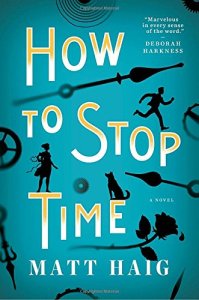
Click to purchase
In years of reading books, there are those that are fine for the short time with them, those that prove good enough to remain with you for a longer time. But every once in a while a novel appears that is so beautiful that it becomes a memory that it will stay with you for a long time. Such a book is Matt Haig’s “How to stop Time.”
Tom Hazard appears like any other 40 year old male. But he is certainly far from that; he is actually more than 400 years of age. Due to a rare shift in his genetic makeup, he ages very slowly and also doesn’t suffer from many illnesses. He was born during the Elizabethan period in England and actually met and talked to William Shakespeare.
Over the years, he discovers that there are others like him and eventually a group is formed as a means of self protection. Why self protection? Simply put, there is a great deal of mistrust on the part of ordinary people that notice when someone does not age over time. Tom actually witnessed his mother being drowned as a witch when it was discovered that she had a son that did not grow older.
Instead of being the blessing that centuries of life could convey, the lack of aging causes those that are affected by it have to constantly change locations in order to remain unnoticed by ordinary people. Tom himself meets and falls in love with a girl in his own time and has a daughter with her. He remains happy and content with their life together until the stares of other people make him realize that in the age he was born in he is a danger to his wife and daughter. He decides to leave them and begins centuries of hiding.
Haig describes the emotions that fill Tom’s mind as he literally runs away from the joys and sorrows of life as normal people experience them. The author is adept at presenting the facts and circumstances present in all the ages Tom lives through. We see him taking part in events that occurred, meeting the people that became famous in each period and experiencing a normal longing for a love that has predeceased him by centuries. A book to savor and think about for a long time to come.
HOW TO STOP TIME by Matt Haig. Viking (February 6, 2018). ISBN 978-0525522874. 336p.
Comments Off on HOW TO STOP TIME by Matt Haig | Book Reviews, Crime Fiction, Fiction | Tagged: Historical, Thriller | Permalink
Posted by Stacy Alesi

Click to purchase
The novel opens during early World War II. A man dressed as a monk is seen entering a monastery which is not his own located in Germany. He is carrying a book and actually doing his best to sneak it in, hiding it from the monks that live there. He finds a place in which religious tomes are kept and proceeds to place it with the others, clearly in a section designed to allow for the discovery of the item when required.
The plot of the novel starts to unfold with the appearance of people famous during the period under discussion. These include Marlene Dietrich, Noel Coward and the infamous Adolf Hitler. A scheme is hatched by Noel Coward to prevent the Nazis from launching an invasion of England. Interestingly enough, the plan relies on something written in the book left in the monastery.
The book shifts to Moscow, Russia after the end of the war with Larissa Mendelova Klint, a college professor doing research instead of going on summer vacation like most of her colleagues and students. She comes across references to the book hidden during WWII unearthing an outline of the scheme hatched by Noel Coward. Fascinated she launches a full scale search for the book and enters full force into that task.
Silvers novel flows smoothly bringing the reader from the mysterious placement of the book through the initiation of the plot and termination of those events. The ending of the novel terminates with a trip to Moscow by the President of the United States. And in a very neat way, events provide a logical setup for another book with Larissa M Klint. A very well done novel indeed.
2/18 Paul Lane
THE BOOKWORM by Mitch Silver. Pegasus Books (February 6, 2018). ISBN 978-1681776415. 352p.
Comments Off on THE BOOKWORM by Mitch Silver | Book Reviews, Crime Fiction, Fiction | Tagged: Historical, Thriller | Permalink
Posted by Stacy Alesi
Comments Off on Top 5 Greatest Author Feuds | Ramblings | Permalink
Posted by Stacy Alesi

Click to purchase
In 2007, Alex Berenson published his first novel featuring John Wells. The concept behind this warrior was incredible. He was working for the CIA and somehow had infiltrated a field unit of the terror group Al Quada remaining with them for three years. He learned their language, learned their methods, and thought highly enough of their religion to become a convert. His return to the CIA was forced by having to openly turn on the group he was with in order to forestall an attack on the west.
In this book, Vinnie Duto, former head of the CIA, is now the president of the United States. He calls John into his office after an attack by terrorists occurs in Dallas, Texas. It is the most horrific attack ever and John is positive that he would be assigned to go after the perpetrators. Somewhat to his surprise the president does not want him to investigate Dallas but to travel to Columbia to pick up information from an old asset living there and deliver it to headquarters. However, the trip turns out to be one of the deadliest assignments John has been assigned to. It brings him into a world of sleeper cells, sniper teams and double agents high up in the United States government.
The information obtained also seems to point out a plot by the Russian government to initiate a coup to take over the American government. And the attack on Dallas is found to be related to the scheme.
Berenson’s John Wells novels are all punctuated by constant action and “The Deceivers” is no exception. A turn in the enemy Wells faces seems to be broadcast by the possibility of the Russian government being involved in planning a coup. The author slightly plays down the possibility of radical Islamists being the cause of world wide terrorism by introducing several Muslims who are against these actions. But whoever the real enemy is John Wells being a part of US anti-terrorism activities will remain in the fight supplying the reader with one engrossing book after another.
2/18 Paul Lane
THE DECEIVERS by Alex Berenson. G.P. Putnam’s Sons (February 6, 2018). ISBN 978-0399176166. 448p.
Comments Off on THE DECEIVERS by Alex Berenson | Book Reviews, Crime Fiction, Fiction | Tagged: Historical, Thriller | Permalink
Posted by Stacy Alesi

Click to purchase
Deb Perelman has a wonderful food blog that has endured for many years, probably because her recipes are great and she is so personally involved. Her cookbook feels just like her blog, and every recipe has a story that goes with it – maybe where the recipe started from, or why her kids like it, or why her husband likes it, or how and why she tweaked it. In other words, her voice shines through and it is a voice worth listening to. She got me at the introduction –
against drudgery.”
The table of contents:
Introduction: Against Drudgery
Breakfast
Salads
Soups and Stews
Sandwiches, Tarts, and Flatbreads
Vegetable Mains
Mean Mains
Sweets
Cookies
Tarts and Pies
Cake
Puddings, Frozen Things, Etc.
Apps, Snacks and Party Foods
To be fair, a not so healthy chunk of this book is dessert based. Deb is a great baker, and her recipes are easy to follow if not always easy to make, if that makes sense.
Deb’s cookbook philosophy is that you shouldn’t have to turn a page to make something, and she fails at that spectacularly here, but I didn’t care.
I made her “Perfect Blueberry Muffins” and while they were good, I wouldn’t say perfect, though to be fair, I’m not sure what a perfect muffin is. I expected these to be larger than they were for some reason, probably because in the explanation of the recipe Deb says, “this makes 9 much prettier towering muffins.” Not so towering, they looked like regular muffins to me. And they stuck to the paper muffin liners. On the other hand, “Loaded Breakast Potato Skins” may be my daughter’s new favorite food. Think of a regular loaded potato skin, all cheesy, with bacon and scallions, and then bake an egg in it. Pure joy! Up next in my kitchen will be “Chicken and Rice, Street Cart Style.” I’m waiting for my husband’s next camping trip, he hates chicken so I’ll make it while he’s gone.
The thing that has been getting the most buzz is “The Party Cake Builder,” an easy solution to making birthday cakes (or any other occasion cakes.) This is well thought out, easy to follow and make your own. Worth the price of admission!
2/18 Stacy Alesi, AKA the BookBitch™
SMITTEN KITCHEN EVERY DAY by Deb Perelman. Knopf; First Edition edition (October 24, 2017). ISBN 978-1101874813. 352p.
Comments Off on SMITTEN KITCHEN EVERY DAY by Deb Perelman | Book Reviews, Cookbook, Nonfiction | Permalink
Posted by Stacy Alesi

Click to purchase
A very tightly written and plotted novel about a young man working for the Israeli government. For personal reasons he makes the decision to approach the American government via their embassy and offer to provide them with information about secret Israeli activities. The offer is snapped up by the agent that he talked with and Alon the young man is interviewed and accepted as a contracted mole. In a completely unexpected turn of events the man accepting Alon is actually a mole in his own right working for the Soviet government.
Alon rises up in the ranks of the Israeli government and becomes a key adviser to the Prime Minister. All the while he has been feeding information to his handler thinking it is going to the Americans when it is actually being sent to Moscow. Suddenly a hint that a spy is entrenched within the high ranks of the Israeli government causes a team to be assembled to catch him and if possible his handler as well. The chase takes the team from Tel Aviv and Moscow into the United States.
The pursuit of the spy by the team’s members is extremely well depicted with reactions of all involved ringing true in the settings of the novel. De Shalit has another book coming out shortly and due to his previous real life position as a high ranking official in the Israeli intelligence community it is a safe bet that that novel will be equally as mesmerizing as “Traitor.”
2/18 Paul Lane
TRAITOR by Jonathan de Shalit. Atria/Emily Bestler Books (January 30, 2018). ISBN 978-1501170485. 320p.
Comments Off on TRAITOR by Jonathan de Shalit | Book Reviews, Crime Fiction, Fiction | Tagged: Thriller | Permalink
Posted by Stacy Alesi
I’m always happy when Lisa has a new book out and she wants to pay a visit here. This one is especially timely. I always learn something fascinating and hope you do, too!
WHAT IS QUALITATIVE EASING AND WHY SHOULD YOU CARE?
If you are like or have a spouse like mine, addicted to the 24-hour news channels, you may have heard more than you cared to about ‘qualitative easing’ as a response to the past decade’s financial crisis. The plan of the Federal Reserve was to first, buy ‘troubled assets’ from banks and financial firms. This took these bad investments off their books and raised their credit scores, as it were, so that they were more able to buy and sell as normal and get the economy moving again. If the economy is an engine, credit is the gas. Second, the Fed bought Treasury securities with the same goal.
Critics read this as the Fed printing money, wagonloads of it, and as we all know from countless Batman and WWII thriller plots, that would cause runaway inflation and plummet the value of a dollar. This is something like what Japan did after their 1991 crisis, and it didn’t work out so well for them.
But the Fed made these purchases by creating reserves, not by printing more cash. This is a very difficult concept to grasp and I can’t quite get it myself, but it means they create an account in the name of the bank for the purchased items. Therefore the securities go from being a liability of the bank’s to an asset held in reserve. These are eventually resold (at a profit, don’t ask me how—this profit goes to the Fed and, as all their profit is, turned over to the Treasury to reduce the national deficit). These events are more like loans than purchases, and they do not affect the amount of cash in circulation at any point in the process, and therefore cannot affect inflation or deflation. (The surest proof that the Fed was not ‘just printing money’ is that the inflation rate stayed at 1.4%. Which is actually not good—zero inflation is not the goal as that means that the economy has stagnated. An inflation rate of between two and four percent is considered ideal.)
Did this ‘fix’ the problem? Partially. The economy started growing again in 2009, only a year and a half after the crash, but the job market did not. Unemployment stayed high, and then the European market crashed. So QE#1 ended in March 2010, but QE#2 began. (Which does not, to my eternal disappointment, refer to a cruise ship.) In the #2 round the Fed decided not to replace the Fannie and Freddie Mac mortgage backed securities, which was a good way to passively tighten up money over time, but kept purchasing the Treasury securities. Again, this avoided messing with the money supply and the inflation or deflation that might result, but gas and food were still high, credit was tight, and unemployment off the charts.
For QE#3, September 2013 to October 2014, the Fed returned to buying Fannie and Freddie securities as well as Treasury ones. Many of these policies were open-ended so some activities continued until QE4 began in June 2017. QE#4 was meant to be the most passive approach to date, simply letting the securities mature instead of replacing them, eventually condensing the national balance sheet. The unemployment rate is well below 5%, inflation hovering around 2%.
Okay, so, why do you care? First of all, inflation and unemployment rates affect everyone. Second, it’s important to see that how the 24-hour news channels characterize events is dependent on what agenda they’re pushing, and a little information can help us take that agenda with a much-needed grain of salt.
But were these QEs and securities and reserve-creating the best thing to do? Who knows? Econ students will be debating these strategies and responses for decades to come. Some might try to make the argument that these responses aggravated an already bad situation. Most will argue that, as bad as things got, they would have been much worse if the government had simply gone the austerity route (like Europe) or done nothing at all. The 2008 crisis created uncharted territory, so there will never be a way to know for sure.

Click to purchase
Bestselling author Lisa Black takes readers on a nailbiting journey to the dark side of justice as forensic expert Maggie Gardiner discovers troubling new details about her colleague Jack Renner, a homicide detective with a brutal approach to law and order . . .
The scene of the crime is lavish but gruesome. In a luxurious mansion on the outskirts of Cleveland, a woman’s body lies gutted in a pool of blood on the marble floor. The victim is Joanna Moorehouse, founder of Sterling Financial. The killer could be any one of her associates.
Maggie knows that to crack the case, she and Jack will have to infiltrate the cutthroat world of high-stakes finance. But the offices of Sterling Financial seethe with potential suspects, every employee hellbent on making a killing. When another officer uncovers disturbing evidence in a series of unrelated murders, the investigation takes a surprising detour.
Only Maggie recognizes the blood-soaked handiwork of a killer who has committed the most heinous of crimes—and will continue killing until he is stopped. Burdened with unbearable secrets, Maggie must make an agonizing choice, while her conscience keeps telling her: she’s next.
PERISH by Lisa Black. Kensington (January 30, 2018). ISBN 978-1496713544. 320 p.

Lisa Black has spent over twenty years in forensic science, first at the coroner’s office in Cleveland Ohio and now as a certified latent print examiner and CSI at a Florida police dept. Her books have been translated into six languages, one reached the NYT Bestseller’s list and one has been optioned for film and a possible TV series.
www.lisa-black.com@LisaBlackAuthor
Comments Off on Guest Blogger: Lisa Black is Back! | Guest Bloggers | Permalink
Posted by Stacy Alesi
You are currently browsing the Stacy Alesi's BookBitch.com™ blog archives for February, 2018.






 Stacy Alesi's BookBitch.com™