Click to purchase
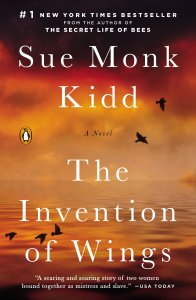
The Invention of Wings is available in paperback May 5th & is perfect for your book group!
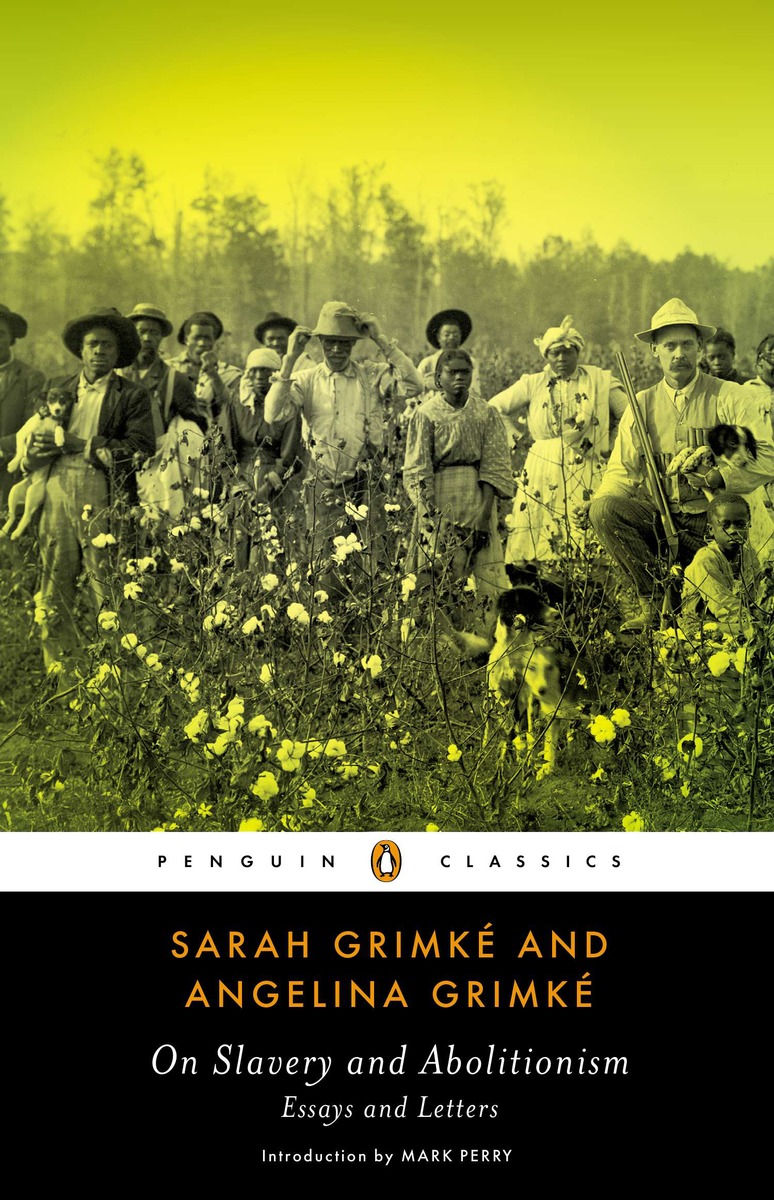
Read on to find out how you can win a copy of The Invention of Wings plus On Slavery and Abolitionism: Essays and Letters (Penguin Classics, On sale: May 5), a collection of Sarah and Angelina’s writings on abolitionism and feminism, edited by Grimké biographer Mark Perry! These reasoned and impassioned pleas can now live on to inspire a new generation of readers, 150 years after the end of the Civil War.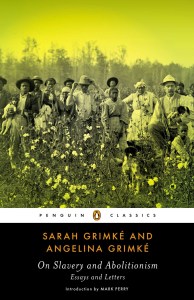
From the celebrated author of The Secret Life of Bees, a New York Times bestselling novel about two unforgettable American women.
Writing at the height of her narrative and imaginative gifts, Sue Monk Kidd presents a masterpiece of hope, daring, the quest for freedom, and the desire to have a voice in the world.
Hetty “Handful” Grimke, an urban slave in early nineteenth century Charleston, yearns for life beyond the suffocating walls that enclose her within the wealthy Grimke household. The Grimke’s daughter, Sarah, has known from an early age she is meant to do something large in the world, but she is hemmed in by the limits imposed on women.
Kidd’s sweeping novel is set in motion on Sarah’s eleventh birthday, when she is given ownership of ten year old Handful, who is to be her handmaid. We follow their remarkable journeys over the next thirty five years, as both strive for a life of their own, dramatically shaping each other’s destinies and forming a complex relationship marked by guilt, defiance, estrangement and the uneasy ways of love.
As the stories build to a riveting climax, Handful will endure loss and sorrow, finding courage and a sense of self in the process. Sarah will experience crushed hopes, betrayal, unrequited love, and ostracism before leaving Charleston to find her place alongside her fearless younger sister, Angelina, as one of the early pioneers in the abolition and women’s rights movements.
Inspired by the historical figure of Sarah Grimke, Kidd goes beyond the record to flesh out the rich interior lives of all of her characters, both real and invented, including Handful’s cunning mother, Charlotte, who courts danger in her search for something better.
This exquisitely written novel is a triumph of storytelling that looks with unswerving eyes at a devastating wound in American history, through women whose struggles for liberation, empowerment, and expression will leave no reader unmoved.
A CONVERSATION WITH SUE MONK KIDD
This is a work of historical fiction inspired by the real Grimké sisters, Sarah and Angelina. How did you discover them and what was it about them that you found to be interesting enough to create a story for a novel? You focus primarily on Sarah. How much of her story is fact and how much did you create?
The novel began with a vague notion that I wanted to write a story about two sisters. I didn’t know initially, who the sisters might be or when and where they lived. Then, while visiting Judy Chicago’s Dinner Party exhibit at the Brooklyn Museum, I came upon the names of Sarah and Angelina Grimké on the Heritage Panels, which list women who’ve made important contributions to history. I discovered they were sisters from Charleston, the same city in which I was living. Embarrassingly enough, I’d never heard of them. Perhaps the most radical females to come out of the antebellum south, they were the first female abolition agents in the country and among the earliest pioneers for women’s rights, and yet they seemed only marginally known. As I began to read about Sarah’s and Angelina’s lives, I became certain they were the sisters I wanted to write about.
Gradually, I was drawn more to Sarah’s story. As dramatic as her life as a reformer was, I was even more compelled by what she overcame as a woman. She belonged to a wealthy, aristocratic, slave-holding family, and before stepping onto the public stage, she experienced intense longings for freedom, for a way to make a difference in the world, and to have a voice of her own, hopes that were repeatedly crushed. She experienced betrayal, unrequited love, self-doubts, ostracism, and suffocating silence. She pressed on anyway.
The novel is a blend of fact and fiction. There’s a great deal of factual detail in it, and I stayed true to the broad historical contours of Sarah’s life. Most, if not all, of her significant events are included. But it was apparent to me that in order to serve the story, I would need to go my own way, as well. I never wanted to write a thinly veiled history. I’m a novelist, and I wanted room to explore and invent. I probably veered off the record as much as I adhered to it, primarily in the scenes related to Sarah’s relationship with the fictional character of Handful. Sarah’s history and the inner life I gleaned of her from my research is the ground floor of her story, but the only way I could bring her fully to life as a character was to find her in my own imagination.
How did you approach writing an enslaved character? How did Hetty Handful Grimké come about?
From the moment I decided to write about the historical figure of Sarah Grimké, I was compelled to also create the story of an enslaved character that could be entwined with Sarah’s. In fact, I felt that I couldn’t write the novel otherwise, that both worlds would have to be represented. Then I discovered that at the age of eleven, Sarah was given a ten-year-old slave named Hetty to be her handmaid. According to Sarah, they became close, and she defied the laws of South Carolina by teaching Hetty to read, for which they were both punished. Nothing further is known of Hetty except that she died of an unspecified disease a short while later. I knew immediately that this was the other half of the story. I wanted to try to bring Hetty to life again and imagine what might have been.
There’s an aphorism in writing that says you should write about what you know, and if I’d followed that rather bad piece of advice, I never would have attempted to write in the voice of a slave. That’s not to say I wasn’t intimidated by the prospect—it would take me further out on the writing limb than I’d ever been. It probably wasn’t arbitrary that in Sarah’s first chapter, I have her announce a little slogan she creates for herself that helps her over the hurdles in her world: “If you must err, do so on the side of audacity.” I could only hope that writing the character of Hetty Handful Grimké was not some audacious erring.
I’d written my other two novels in first person. I love the interiority of it, how intimate it feels, nevertheless, I started off by telling myself I would write Handful from a third person perspective, which seemed a little more removed. I think the word I’m looking for here is safer. I hadn’t written more than two pages, however, when Handful began talking in the first person. My need to inhabit her more fully kept breaking in. Finally, I just gave up and let her talk. While writing this novel, I read an interview with author Alice Walker, who, in speaking of her mother, said, “She was all over my heart, so why shouldn’t she be in literature?” I felt that way about Handful.
With this novel, you join a tradition of depicting slavery in an open and unflinching way, though you’ve written about a form of it perhaps less known to most readers: urban slavery. Can you give us a glimpse of it?
When a person thinks of American slavery, probably what comes to mind are plantations, cotton fields, and slave cabins. Urban slavery, however, was quite different. In antebellum Charleston slaves worked in the city’s fine houses and mansions or in the walled work yards behind them. They lived in small rooms above the work yard structures—the kitchen house, the laundry, the carriage house, and the stables. Large numbers of slaves were hired out to work away from their residences, providing labor for the wharves, the lumber yards, and other places of business. Slaves ran stalls in the city market, peddled wares on the street, and crisscrossed the city, carrying messages and running errands for their owners. On Sundays, they were often required to show up at their owners’ churches and sit in the balcony. Slave auctions took place right on the street up until the late 1850s. Every day, the streets teemed with slaves, who nicked time to fraternize in alleys and on street corners. The city was alive with networks of information passed slave to slave and yard to yard, and watchful eyes were everywhere. Urban slavery was built on an intricate system of surveillance and control: curfews, passes, badges, searches, and ordinances that dictated how slaves should behave on the streets—all of it enforced by the presence of militia companies and the City Guard. Infractions could send slaves to an establishment known as the Work House, where they were whipped or otherwise punished. Even more disturbing, owners could arbitrarily send slaves to the Work House to be punished for a fee. Urban slavery might have looked and functioned differently from plantation slavery, but it was every bit as brutal.
The Invention of Wings takes place in the early part of the nineteenth century in Charleston. What was it like to write a novel set two hundred years ago? How is historical fiction relevant for readers today?
Basically, I sat down at my computer almost daily for three and half years and transported myself back in time. I would be in the grand Grimké house on East Bay Street in Charleston, or in the work yard where the Grimké slaves carried on behind hidden walls, or I might be on a ship sailing north, or in the attic room of an abolitionist home in Philadelphia. My husband joked that I spent more time in the nineteenth century than I did in the twenty-first. My aim was to create a “world” for the reader to enter, one as richly textured, tangible, and authentic as I could make it. Of course, the way into the nineteenth century is through an awful lot of research. I spent six months reading before I began writing, and I made lots of field trips to libraries, museums, historical societies, and historic houses, all of which I may have enjoyed a little too much because I finally had to make myself stop reading and traipsing about and start writing.
It was a revelation to me that two of the great movements of the twentieth century—Civil Rights and feminism— were fueled by early nineteenth century innovations of thought about abolition and women’s rights, two major motifs in my novel. I was incredibly moved by that, by the far reaching power of what took place during the thirty-five years I was writing about. That we are the sum of our history has never seemed truer to me, and I think it’s why historical fiction has the potential to be sharply relevant. Sometimes the best way, even the only way, to see ourselves clearly in the present is to take a good look at where we came from. For instance, I like to imagine that people might read about the cruelties and oppressions in the 1800s and find that it opens their eyes wider to the cruelties and oppressions that exist today. As hard as it is to believe, the evils of slavery were often invisible to those who saw it as essential to their way of life. Something like that might just make us wonder about the way evil hides in plain sight today and gathers while no one is looking. Undoubtedly, the biggest revelation for me in writing this novel was that I was writing as much about the present as the past.
In both The Invention of Wings and Bees you address issues of and explore racial relations. What inspires this interest?
During my childhood in the South in the fifties and sixties, I witnessed terrible racial injustices and divides. I grew up amid the backdrop of separate water fountains, black maids riding in the back seats of white ladies’ cars, Rosa Parks, and Civil Rights marches. One of my earliest memories is seeing the Ku Klux Klan on the street in my small hometown in Georgia and the absolute terror I felt. I was thirteen when Martin Luther King, Jr. was jailed in the town where I was born, twenty miles from where I then lived. I graduated from the first integrated class at my high school, and I can still see the barrage of balled up notebook paper that was thrown at black students as they walked to class, a scene that ended up in the pages of The Secret Life of Bees. This is the stuff of my childhood and adolescence; it’s the stuff of my history.
I imagine there’s always some mystery involved in why novelists gravitate to certain subjects, but I believe I’ve been drawn to write about racial themes because they are part of me, and also because they matter deeply to me. I can’t help but feel a social responsibility about it as a writer. Racism is the great wound and sin of the South and indeed, the great wound and original sin of America. Two hundred and forty-six years of slavery was an American holocaust, and its legacy is racism. I don’t think we’ve fully healed the wound or eradicated the sin. For all the great strides we’ve made, that legacy still lingers.
You have a theme of young girls and women asserting their voices and thinking beyond the time in which they live—like Lily in Bees, and Sarah, Angelina, and Handful in The Invention of Wings. What stirs your interest in such forward thinking women?
Empowering girls and women feels very personal to me. Just as I grew up in a time and place of racial injustice and divides, I also came of age in pre-feminist America. In the South, that was saying a great deal. In 1963, the same year Betty Friedan published The Feminine Mystique and reignited the women’s revolution, I sat in a home economics class in high school, hemming skirts and learning how to make a home into a man’s castle. I still recall the list of occupations for women I copied off the blackboard: teacher, nurse, secretary, sales clerk, homemaker… There were less than twenty of them. I remember this moment quite well because I harbored a deep and formidable desire to be a writer, and it was nowhere on the roster. When I headed to college, I studied nursing. That was a colossal failure of courage on my part, mine alone. I hadn’t yet figured out how to think and act outside the confines of the world that shaped me. It took eight years after graduating from college for me to break out, pursue writing and find a voice of my own. Oddly enough, it wasn’t Friedan’s book that shook me. It was Kate Chopin’s novel, The Awakening. Even though it’s set in the 19th century or maybe because it’s set there, the story of Edna Pontellier’s agonizing struggle against the limits her culture placed on women nearly leveled me. The lives of Sarah and Angelina Grimké affected me in a similar way. I fell in love with their bravery. They started at ground zero with women’s rights. At twelve, Sarah, bless her, earnestly believed she could become the first female lawyer in America.
I know, the world is radically different now, but there is something global, resounding and even urgent about empowering girls and women. We seem to understand now that the world is going to hell in a hand basket without them, that there are still boundaries out there, whether poverty, or cultural expectations, or political and religious restrictions, or their own lack of selfhood and vision. I’m a believer that girls and women need all the stories of courage and daring they can get.
The relationships between mothers and daughters are a common thread in your work. In The Invention of Wings, you present two parallel mother/daughter narratives, as well as a sister narrative. Did you have this in mind from the start or did it develop as you wrote?
I intended from the outset to write a story about sisters. I never had a sister; I have three brothers. I once heard novelist Lee Smith say, tongue-in-cheek, that writers don’t write autobiographically, they write about things they want to try out. Maybe that’s what I was doing. Sarah and Angelina’s sisterhood was remarkable from the start. Sarah, twelve years older than Angelina, was also her godmother. She acted as both a mother and a sister to the child, creating an exceptionally complex relationship. The two were alike in thought, but different in nature. Sarah was the introvert, the writer, the thinker, a brilliant theoretician, and the plainer looking. Angelina was the extrovert, the orator, the doer, the dazzler, leading the charge. “Nina was one wing, I was the other,” Sarah says in the novel.
As for the parallel mother-daughter relationships in the story, I didn’t plan them at all. I seem to end up writing about mothers and daughters, perhaps because the relationships between them are seeded with so much potential for intimacy, separation, love, and conflict. They are rarely casual, irrelevant, or finished. In the novel, there’s a vivid contrast between the relationship Sarah has with her mother and the one Handful has with hers. From historical accounts, Mrs. Grimké was a stern, distant mother, though she clearly loved all of her children, eleven of whom survived, all cared for by a slave known as the nursery mauma. Sarah and Angelina were her two “foreign” children, as she called them. They didn’t see eye to eye with their mother on much of anything. Handful, however, slept in the same bed with her mother, Charlotte, a metaphor, perhaps, for the closeness that sustained them in a place that was filled with the threat of separation. Handful took her solace, her shelter, and her strength from her mother.
I might add that developing Sarah’s relationship to her father and to her brother, Thomas, was just as important to me as creating the one she had with her mother, perhaps even more so. Her father was a judge on South Carolina’s Supreme Court and her brother was an esteemed lawyer, and I wanted to show the enormity of their presence in her life as she grew up. I tried to portray what a father’s daughter Sarah truly was, emulating him and identifying with both him and her brother over and against her mother.
Storytelling happens in many ways in your new novel. Handful’s mother, Charlotte, tells her story through a quilt. What inspired you to portray her story in this way?
I was inspired by the magnificent quilts of Harriet Powers, who was born into slavery in 1837 in Georgia. She used West African appliqué technique and designs to tell stories, mostly about Biblical events, legends, and astronomical occurrences. One of her two surviving quilts resides at the National Museum of American History in Washington, D.C. A textile specialist at the museum graciously led me back into the labyrinth of the Smithsonian archives to view it. Gazing at the fifteen squares on Power’s quilt struck me like looking at the pages of an ancient, illumined book. They were each a masterpiece of art and narration.
It seemed more than plausible to me that many enslaved women, forbidden to read and write, would have devised subversive ways to voice themselves, to keep their memories alive, and to preserve their African heritage. In my novel, Charlotte is the Grimké’s rebellious and accomplished seamstress, and I envisioned her using needle and cloth the way others use paper and pen, attempting to set down the events of her life in a single quilt. She appliqués it with strange, beautiful images—slaves flying through the air, spirit trees with their trunks wrapped in red thread—but she also sews violent and painful images of her punishments and loss. The quilt in the novel is meant to be more than a warm blanket or an artful piece of handiwork. It is Charlotte’s story. As she tells her daughter, Handful, the quilt squares are pieces of her, the same as the meat on her bones.
You’ve managed to capture the voice of the period. You get the idiom, dialect, and cadence of the language of the day on paper. How did you find the voices of your two narrators?
The voice of Sarah turned out to be one of my biggest challenges. I rewrote her chapters in the early part of the book over and over before I felt like I found her voice. I’d read the real life Grimké sisters’ diaries and essays, and they gave me an extraordinary glimpse into their lives, but their writing was rendered in nineteenth century language, wrapped in rhetoric, piety and stilted phrases. I wanted Sarah’s voice in my novel to feel authentic and carry some of the vernacular of the time, but I knew I had to bring some modern sensibility to it. Writing her voice was all about loosening it. I decided that my task was to tap into her inner life and set her free to speak from that timeless place, as well as from the time in which she lived.
By comparison, Handful’s voice came with considerable more ease. I was certain only that I didn’t want it to be weighed heavily with dialect, and that it must have traces of humor. I read a great many first person slave narratives from the nineteenth century, as well as the Federal Writers’ Project of the 1930s, and they gave me a lot of valuable insights. And I think Handful’s voice must surely carry traces of the African-American women from my own childhood whose voices go on resonating in me, and also of the quilting women of Gee’s Bend, whose voices I read and reread. But in the end, what I most wanted was for Handful’s voice to be all her own—the voice of a slave who has learned to read and write, one marked with Handful’s particular idiosyncrasies and formed from the workings of her character.
Sarah and Handful’s relationship begins when they are children. How did you go about writing the relationship between these two characters?
It’s hard to come up with a relationship between characters more troubling to write about than that of an owner and a slave. Even if the owner is an unwilling one, even if she has an abolitionist’s heart beating in her chest, as Sarah does, it’s still a problematic situation. It was the thing that kept me up at nights—Handful and Sarah’s complicated connection and whether I was getting it right. In the novel, their relationship spans three and half decades, many of which they spend as constant companions. To a large extent, they mold one another’s lives and shape each other’s destinies. There’s an undeniable caring between them, but also the built-in gulf of slavery. Their relationship is disfigured by so many things: guilt, shame, pity, resentment, defiance, estrangement… I tried to create a relationship that allows for all of that, yet also has room for surprise, redemption, and even love. Someone who read an early copy of the novel commented that the two women create a sisterhood against all odds. Perhaps they do—an uneasy, but saving sisterhood.
Sarah and Handful battle for different kinds of freedom. Handful remarks to Sarah, “My body might be a slave, but not my mind. For you, it’s the other way around.” How did you develop the issue of freedom in these two characters?
Handful and Sarah are both imprisoned in their own particular way. As a white woman in South Carolina in the early 1800s, Sarah’s life was vastly curtailed. Women then had few rights, not to property or even to their own children. They couldn’t vote, testify in court, or make a will. Essentially, they were the property of their husbands. Their singular purpose in life was to marry, have children, and live their lives in the domestic sphere. And yet, their lack of freedom could not compare to the horrific subjugation of enslaved women, whose entire lives were determined by their owners and whose suffering was far worse. I felt like the main thing in developing Handful’s and Sarah’s quests for freedom was to never lose sight of that.
As I wrote, I came to see that freedom has all sorts of nuances and dimensions. Handful’s assertion that her body is a slave, but not her mind, and that for Sarah it’s the other way around, comes at a certain looming moment in the story, as Sarah struggles with the dictates of her family, her society, and her religion. Handful is trying to tell Sarah a truth she knows only too well herself, that one’s mind can become a cage, too. There’s an earlier scene in the novel in which Handful willfully locks the door and takes a bath in the Grimké’s majestic copper bathtub. I can’t tell you how much sheer pleasure I derived from writing this scene. Handful’s bath is tinged with defiance, but it becomes a baptism into her own worth, a kind of coming to herself. She begins to understand that even though her body is trapped in slavery, her mind is her own. Finding one’s sense of self, and the boldness to express that self, is one form of freedom that needed to be developed in both characters. Handful just found it much sooner than Sarah.
A number of your characters were actual people, Denmark Vesey among them. How did he come into the story?
As I began my research, I realized that the time frame of the novel overlapped with one of the largest and most daring slave plots in American history. It unfolded in the heart of Charleston in the early 1820s and was led by ex-slave Denmark Vesey, whose name has remained more or less buried. I became absorbed by his story and immediately began to weave him into the novel, intersecting his life with Handful’s and Charlotte’s. His presence in the novel was a serendipity for me. It brought another male character into the center of the story, as well as adding some intrigue and drama. And it allowed me a way to acknowledge the enslaved and free black Americans who fought, plotted, resisted, and died for the sake of freedom. Depicting all slaves as passive, compliant, and happy is a travesty that was perpetuated for a long time, and even in the course of writing this novel, I encountered people who expressed that opinion to me. The truth is, slaves rebelled and subverted the system in all sorts of cunning and courageous ways. I tried to capture some of that through Handful and Charlotte, as well as Vesey and his lieutenants.
Without revealing too much, what does the title The Invention of Wings symbolize?
I’m one of those writers who likes to have a title before I begin to write. A title helps me to shape my intention and my understanding of what I’m doing. It provides a focus, as well as giving me something concrete and visual I can play with. For me, the most important thing to keep in mind about the imagination is that it wants to play. I will spend an inordinate amount of time writing down possible titles until I find one my imagination seizes upon. When The Invention of Wings popped into my head, my imagination sort of lit up. Wings, of course, symbolize flight and freedom, and they became a central metaphor in the story. I discovered an American black folktale about people in Africa being able to fly and then losing their wings when captured into slavery, and that notion began to slip into the story in different ways. Sometimes, while writing, I listened to songs the slaves sang: “Now let me fly… now let me fly, now let me fly way up high.” The title, The Invention of Wings, suggests the sweeping social movements toward freedom that began erupting at the time—abolition and women’s rights—but the real essence of the title for me is the individual and personal ways my characters invented their wings.
What do you want people to take away from reading The Invention of Wings?
I most want the reader to take away a felt experience of the story, of what slavery might have been like for someone or what it was like for a woman before she had any rights. I want the reader to feel as if he or she has participated in the interior lives of the characters and felt something of their yearnings, sufferings, joys, and braveries. That’s a large hope. Empathy—taking another’s experience and making it one’s own—is one of the most mysterious and noble transactions a human can have. It’s the real power of fiction. In the Author’s Note at the end of the novel, I quote some words by Professor Julius Lester, words I kept visible on my desk as I wrote: “History is not just facts and events. History is also a pain in the heart and we repeat history until we are able to make another’s pain in the heart our own.”
RECIPES
Huguenot Torte
This quintessential old Charleston delicacy will provide the perfect complement to your book club’s discussion.
Ingredients
4 eggs
3 cups sugar
8 tablespoons all-purpose flour
5 teaspoons baking powder
½ teaspoon salt
3 large tart apples, cored and chopped (about 2 cups)
2 cups chopped pecans
2 teaspoons pure vanilla extract
Whipped cream for serving
Directions
Preheat oven to 325ºF. Grease two 17¼ x 11½ inch baking pans. Beat eggs in electric mixer on medium speed until frothy and lemon-colored, about 4 minutes. Gradually add sugar, flour, baking powder, and salt, beat until incorporated. Divide mixture between baking pans, and bake about 45 minutes or until crusty and golden brown. To serve, cut into pieces and scoop up with a spatula; stack on a large plate. Cover with whipped cream and a sprinkling of the chopped nuts.
Blackbird Cocktail
If your book club enjoys cocktails with their book discussion, try this delicious Blackbird while you talk about The Invention of Wings.
Ingredients
2 parts whiskey or bourbon
1 part half and half or light cream
1 part egg white
To make:
Fill a cocktail shaker with ice cubes. Add all other ingredients. Shake and strain into a chilled old-fashioned glass. Enjoy responsibly.
How to Brew a Perfect Pot of Tea
For your next book club meeting, brew tea the old-fashioned way using loose leaf tea and a beautiful teapot. Here’s a step-by-step guide to making a perfect pot.
What you’ll need:
Loose leaf black tea. Darjeeling and Earl Grey are classic choices.
Add-ins: Milk, lemon slices, and sugar cubes (all optional)
Tea kettle Teapot—you’ll need one large enough to serve all your guests
Strainer—if your teapot doesn’t have a built in strainer, you’ll need one
Spoons, cups, and napkins
Tea towel or tea cozy—you can also use a regular kitchen towel
Creamer Tray and sugar cube tongs (optional)
Preparing
• If you’re using milk, start warming it on the stove. Warm milk is wonderful with freshly brewed tea!
• Warm your teapot by running it (and the lid) under very hot water. You can also warm your tea cups this way.
• Get your cups, strainer, and add-ins ready. Putting everything on a tray adds convenience and style.
• Add your tea to the teapot. Use roughly one teaspoon of tea for every 8 oz of water. Your tea packaging should also have instructions on how much to use. If your teapot has a strainer, add the loose tea into the strainer. If not, simply add the tea directly into the pot.
• When your water has reached a boil, turn off the stove and pour the water over the tea. Put the lid on the teapot and wrap it with a towel or a cozy to prevent cooling.
• Steep tea anywhere from 3-5 minutes, depending on how strong you like it.
• Pour the warm milk into your creamer or other pitcher. Remove the strainer from the tea (if applicable). If you’re using a separate strainer, place it over the tea cup before pouring the tea.
• Add milk or lemon to your cup first and then add the tea. Breathe deeply and enjoy with your Huguenot Torte or other treats!
AUTHOR’S NOTE
The following is a portion of the Author’s Note. The full version can be found on page 361 of The Invention of Wings.
In 2007, I traveled to New York to see Judy Chicago’s The Dinner Party at the Brooklyn Museum. At the time, I was in the midst of writing a memoir, Traveling with Pomegranates, with my daughter, Ann Kidd Taylor, and I wasn’t thinking about my next novel. I had no idea what it might be about, only a vague notion that I wanted to write about two sisters. Who those sisters were, when and where they lived, and what their story might be had not yet occurred to me.
The Dinner Party is a monumental piece of art, celebrating women’s achievements in Western civilization. Chicago’s banquet table with its succulent place settings honoring 39 female guests of honor rests upon a porcelain tiled floor inscribed with the names of 999 other women who have made important contributions to history. It was while reading those 999 names on the Heritage Panels in the Biographic Gallery that I stumbled upon those of Sarah and Angelina Grimké, sisters from Charleston, South Carolina, the same city in which I then lived. How could I have not heard of them?
Leaving the museum that day, I wondered if I’d discovered the sisters I wanted to write about. Back home in Charleston, as I began to explore their lives, I became passionately certain.
Sarah and Angelina were born into the power and wealth of Charleston’s aristocracy, a social class that derived from English concepts of landed gentry. They were ladies of piety and gentility, who moved in the elite circles of society, and yet few nineteenth-century women ever “misbehaved” so thoroughly. They underwent a long, painful metamorphosis, breaking from their family, their religion, their homeland, and their traditions, becoming exiles and eventually pariahs in Charleston. Fifteen years before Harriet Beecher Stowe wrote Uncle Tom’s Cabin, which was wholly influenced by American Slavery As It Is, a pamphlet written by Sarah, Angelina, and Angelina’s husband, Theodore Weld, and published in 1839, the Grimké sisters were out crusading not only for the immediate emancipation of slaves, but for racial equality, an idea that was radical even among abolitionists. And ten years before the Seneca Falls Convention, initiated by Lucretia Mott and Elizabeth Cady Stanton, the Grimkés were fighting a bruising battle for women’s rights, taking the first blows of backlash.
My aim was not to write a thinly fictionalized account of Sarah Grimké’s history, but a thickly imagined story inspired by her life. During my research, delving into diaries, letters, speeches, newspaper accounts, and Sarah’s own writing, as well as a huge amount of biographical material, I formed my own understanding of her desires, struggles, and motivations. The voice and inner life I’ve given Sarah are my own interpretation.
All of the enslaved characters in the novel are conjured from my imagination, with the exception of Denmark Vesey’s lieutenants, who were actual figures: Gullah Jack, Monday Gell, Peter Poyas, and Rolla and Ned Bennett. All but Gell were hanged for their roles in the plotted revolt. Vesey himself was a free black carpenter, whose life, plot, arrest, trial, and execution I’ve tried to represent relatively close to historical accounts. I didn’t concoct that odd detail about Vesey winning the lottery with ticket number 1884, then using the payoff to buy both his freedom and a house on Bull Street. Frankly, I wonder if I would’ve had the courage to make such a thing up. In public reports, Vesey was said to have been hanged at Blake’s Lands along with five of his conspirators, but I chose to portray an oral tradition that has persisted among some black citizens of Charleston since the 1820s, which states that Vesey was hanged alone from an oak tree in order to keep his execution shrouded in anonymity. Vesey was said to have kept a number of “wives” around the city and to have fathered a number of children with them, so I took the liberty of making Handful’s mother one of these “wives” and Sky his daughter.
Some historians have doubts about whether Vesey’s planned slave insurrection truly existed or to what extent, but I have followed the opinion that not only was Vesey more than capable of creating such a plot, he attempted it. I wanted this work to acknowledge the many enslaved and free black Americans who fought, plotted, resisted, and died for the sake of freedom. Reading about the protest and escapes of various actual female slaves helped me to shape the characters and stories of Charlotte and Handful.
The story quilt in the novel was inspired by the magnificent quilts of Harriet Powers, an enslaved woman from Georgia who used African appliqué technique to tell stories about biblical events and historical legends. Her two surviving quilts are archived at the National Museum of American History in Washington, D. C., and the Museum of Fine Arts, Boston. I made a pilgrimage to Washington to see Powers’ quilt, and after viewing it, it seemed plausible that enslaved women, forbidden to read and write, could have devised subversive ways to voice themselves, to keep their memories alive, and to preserve the heritage of their African traditions. I envisioned Charlotte using cloth and needle as others use paper and pen, creating a visual memoir, attempting to set down the events of her life in a single quilt. One of the most fascinating parts of my research had to be the hours I spent reading about slave quilts and the symbols and imagery in African textiles, which introduced me to the notion of black triangles representing blackbird wings.
In writing The Invention of Wings, I was inspired by the words of Professor Julius Lester, which I kept propped on my desk: “History is not just facts and events. History is also a pain in the heart and we repeat history until we are able to make another’s pain in the heart our own.”
To win your own copy of both The Invention of Wings + On Slavery and Abolitionism, please send an email to contest@gmail.com with “SUE MONK KIDD” as the subject.
You must include your U.S. street address in your email.
All entries must be received by May 15, 2015. One (1) name will be drawn from all qualified entries and notified via email. This contest is open to all adults over 18 years of age in the United States only. Your books will be sent by the publisher.
One entry per email address. Subscribers to the monthly newsletter earn an extra entry into every contest. Follow this blog to earn another entry into every contest. Winners may win only one time per year (365 days) for contests with prizes of more than one book. Your email address will not be shared or sold to anyone.
4/15 Stacy Alesi, AKA the BookBitch



 Posted by Stacy Alesi









 Stacy Alesi's BookBitch.com™