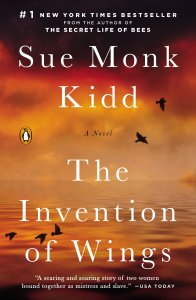
Guest Blogger: Sue Monk Kidd

April 30, 2015
Click to purchase

Click to purchase

The Invention of Wings is available in paperback May 5th & is perfect for your book group!  

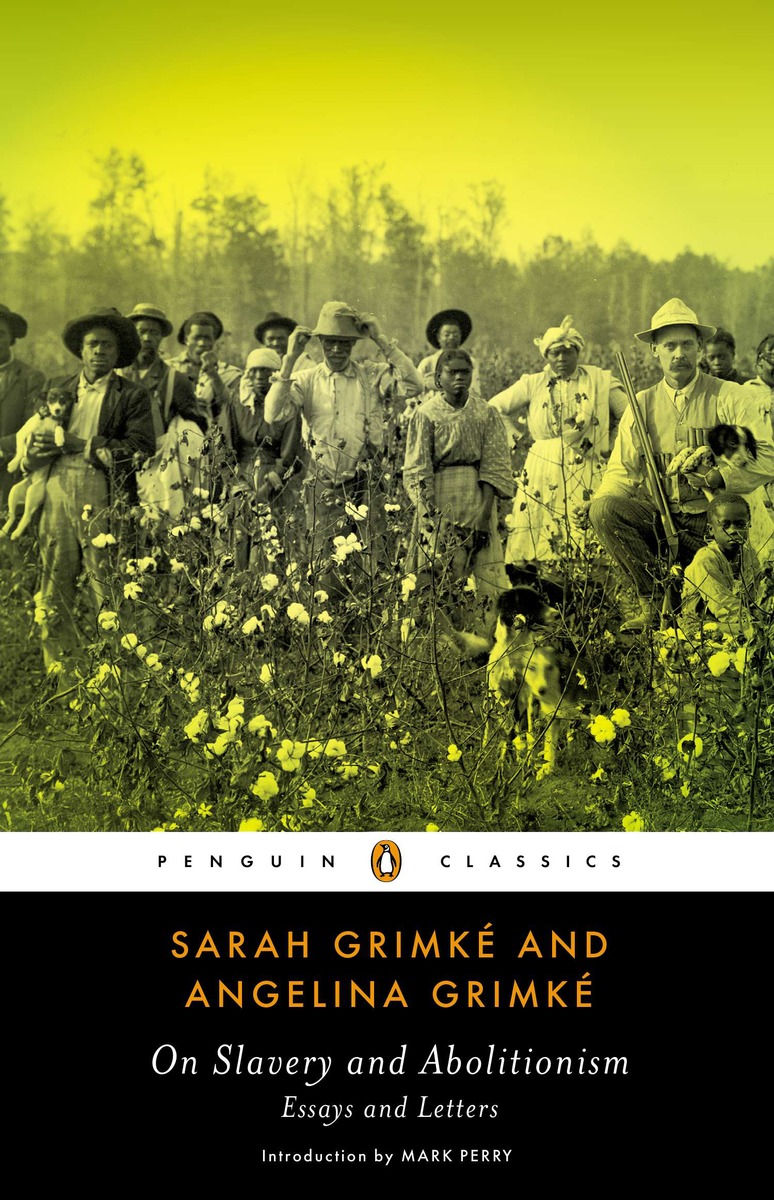
Read on to find out how you can win a copy of The Invention of Wings plus On Slavery and Abolitionism: Essays and Letters (Penguin Classics, On sale: May 5), a collection of Sarah and Angelina’s writings on abolitionism and feminism, edited by Grimké biographer Mark Perry! These reasoned and impassioned pleas can now live on to inspire a new generation of readers, 150 years after the end of the Civil War.Cover.On Slavery
From the celebrated author of The Secret Life of Bees, a New York Times bestselling novel about two unforgettable American women.

Writing at the height of her narrative and imaginative gifts, Sue Monk Kidd presents a masterpiece of hope, daring, the quest for freedom, and the desire to have a voice in the world.

Hetty “Handful” Grimke, an urban slave in early nineteenth century Charleston, yearns for life beyond the suffocating walls that enclose her within the wealthy Grimke household. The Grimke’s daughter, Sarah, has known from an early age she is meant to do something large in the world, but she is hemmed in by the limits imposed on women.

Kidd’s sweeping novel is set in motion on Sarah’s eleventh birthday, when she is given ownership of ten year old Handful, who is to be her handmaid. We follow their remarkable journeys over the next thirty five years, as both strive for a life of their own, dramatically shaping each other’s destinies and forming a complex relationship marked by guilt, defiance, estrangement and the uneasy ways of love.

As the stories build to a riveting climax, Handful will endure loss and sorrow, finding courage and a sense of self in the process. Sarah will experience crushed hopes, betrayal, unrequited love, and ostracism before leaving Charleston to find her place alongside her fearless younger sister, Angelina, as one of the early pioneers in the abolition and women’s rights movements.

Inspired by the historical figure of Sarah Grimke, Kidd goes beyond the record to flesh out the rich interior lives of all of her characters, both real and invented, including Handful’s cunning mother, Charlotte, who courts danger in her search for something better.

This exquisitely written novel is a triumph of storytelling that looks with unswerving eyes at a devastating wound in American history, through women whose struggles for liberation, empowerment, and expression will leave no reader unmoved.

A CONVERSATION WITH SUE MONK KIDD

This is a work of historical fiction inspired by the real Grimké sisters, Sarah and Angelina. How did you discover them and what was it about them that you found to be interesting enough to create a story for a novel? You focus primarily on Sarah. How much of her story is fact and how much did you create?

The novel began with a vague notion that I wanted to write a story about two sisters. I didn’t know initially, who the sisters might be or when and where they lived. Then, while visiting Judy Chicago’s Dinner Party exhibit at the Brooklyn Museum, I came upon the names of Sarah and Angelina Grimké on the Heritage Panels, which list women who’ve made important contributions to history. I discovered they were sisters from Charleston, the same city in which I was living. Embarrassingly enough, I’d never heard of them. Perhaps the most radical females to come out of the antebellum south, they were the first female abolition agents in the country and among the earliest pioneers for women’s rights, and yet they seemed only marginally known. As I began to read about Sarah’s and Angelina’s lives, I became certain they were the sisters I wanted to write about.

Gradually, I was drawn more to Sarah’s story. As dramatic as her life as a reformer was, I was even more compelled by what she overcame as a woman. She belonged to a wealthy, aristocratic, slave-holding family, and before stepping onto the public stage, she experienced intense longings for freedom, for a way to make a difference in the world, and to have a voice of her own, hopes that were repeatedly crushed. She experienced betrayal, unrequited love, self-doubts, ostracism, and suffocating silence. She pressed on anyway.

The novel is a blend of fact and fiction. There’s a great deal of factual detail in it, and I stayed true to the broad historical contours of Sarah’s life. Most, if not all, of her significant events are included. But it was apparent to me that in order to serve the story, I would need to go my own way, as well. I never wanted to write a thinly veiled history. I’m a novelist, and I wanted room to explore and invent. I probably veered off the record as much as I adhered to it, primarily in the scenes related to Sarah’s relationship with the fictional character of Handful. Sarah’s history and the inner life I gleaned of her from my research is the ground floor of her story, but the only way I could bring her fully to life as a character was to find her in my own imagination.

How did you approach writing an enslaved character? How did Hetty Handful Grimké come about?

From the moment I decided to write about the historical figure of Sarah Grimké, I was compelled to also create the story of an enslaved character that could be entwined with Sarah’s. In fact, I felt that I couldn’t write the novel otherwise, that both worlds would have to be represented. Then I discovered that at the age of eleven, Sarah was given a ten-year-old slave named Hetty to be her handmaid. According to Sarah, they became close, and she defied the laws of South Carolina by teaching Hetty to read, for which they were both punished. Nothing further is known of Hetty except that she died of an unspecified disease a short while later. I knew immediately that this was the other half of the story. I wanted to try to bring Hetty to life again and imagine what might have been.

There’s an aphorism in writing that says you should write about what you know, and if I’d followed that rather bad piece of advice, I never would have attempted to write in the voice of a slave. That’s not to say I wasn’t intimidated by the prospect—it would take me further out on the writing limb than I’d ever been. It probably wasn’t arbitrary that in Sarah’s first chapter, I have her announce a little slogan she creates for herself that helps her over the hurdles in her world: “If you must err, do so on the side of audacity.” I could only hope that writing the character of Hetty Handful Grimké was not some audacious erring.

I’d written my other two novels in first person. I love the interiority of it, how intimate it feels, nevertheless, I started off by telling myself I would write Handful from a third person perspective, which seemed a little more removed. I think the word I’m looking for here is safer. I hadn’t written more than two pages, however, when Handful began talking in the first person. My need to inhabit her more fully kept breaking in. Finally, I just gave up and let her talk. While writing this novel, I read an interview with author Alice Walker, who, in speaking of her mother, said, “She was all over my heart, so why shouldn’t she be in literature?” I felt that way about Handful.

With this novel, you join a tradition of depicting slavery in an open and unflinching way, though you’ve written about a form of it perhaps less known to most readers: urban slavery. Can you give us a glimpse of it?

When a person thinks of American slavery, probably what comes to mind are plantations, cotton fields, and slave cabins. Urban slavery, however, was quite different. In antebellum Charleston slaves worked in the city’s fine houses and mansions or in the walled work yards behind them. They lived in small rooms above the work yard structures—the kitchen house, the laundry, the carriage house, and the stables. Large numbers of slaves were hired out to work away from their residences, providing labor for the wharves, the lumber yards, and other places of business. Slaves ran stalls in the city market, peddled wares on the street, and crisscrossed the city, carrying messages and running errands for their owners. On Sundays, they were often required to show up at their owners’ churches and sit in the balcony. Slave auctions took place right on the street up until the late 1850s. Every day, the streets teemed with slaves, who nicked time to fraternize in alleys and on street corners. The city was alive with networks of information passed slave to slave and yard to yard, and watchful eyes were everywhere. Urban slavery was built on an intricate system of surveillance and control: curfews, passes, badges, searches, and ordinances that dictated how slaves should behave on the streets—all of it enforced by the presence of militia companies and the City Guard. Infractions could send slaves to an establishment known as the Work House, where they were whipped or otherwise punished. Even more disturbing, owners could arbitrarily send slaves to the Work House to be punished for a fee. Urban slavery might have looked and functioned differently from plantation slavery, but it was every bit as brutal.

The Invention of Wings takes place in the early part of the nineteenth century in Charleston. What was it like to write a novel set two hundred years ago? How is historical fiction relevant for readers today?

Basically, I sat down at my computer almost daily for three and half years and transported myself back in time. I would be in the grand Grimké house on East Bay Street in Charleston, or in the work yard where the Grimké slaves carried on behind hidden walls, or I might be on a ship sailing north, or in the attic room of an abolitionist home in Philadelphia. My husband joked that I spent more time in the nineteenth century than I did in the twenty-first. My aim was to create a “world” for the reader to enter, one as richly textured, tangible, and authentic as I could make it. Of course, the way into the nineteenth century is through an awful lot of research. I spent six months reading before I began writing, and I made lots of field trips to libraries, museums, historical societies, and historic houses, all of which I may have enjoyed a little too much because I finally had to make myself stop reading and traipsing about and start writing.

It was a revelation to me that two of the great movements of the twentieth century—Civil Rights and feminism— were fueled by early nineteenth century innovations of thought about abolition and women’s rights, two major motifs in my novel. I was incredibly moved by that, by the far reaching power of what took place during the thirty-five years I was writing about. That we are the sum of our history has never seemed truer to me, and I think it’s why historical fiction has the potential to be sharply relevant. Sometimes the best way, even the only way, to see ourselves clearly in the present is to take a good look at where we came from. For instance, I like to imagine that people might read about the cruelties and oppressions in the 1800s and find that it opens their eyes wider to the cruelties and oppressions that exist today. As hard as it is to believe, the evils of slavery were often invisible to those who saw it as essential to their way of life. Something like that might just make us wonder about the way evil hides in plain sight today and gathers while no one is looking. Undoubtedly, the biggest revelation for me in writing this novel was that I was writing as much about the present as the past.

In both The Invention of Wings and Bees you address issues of and explore racial relations. What inspires this interest?

During my childhood in the South in the fifties and sixties, I witnessed terrible racial injustices and divides. I grew up amid the backdrop of separate water fountains, black maids riding in the back seats of white ladies’ cars, Rosa Parks, and Civil Rights marches. One of my earliest memories is seeing the Ku Klux Klan on the street in my small hometown in Georgia and the absolute terror I felt. I was thirteen when Martin Luther King, Jr. was jailed in the town where I was born, twenty miles from where I then lived. I graduated from the first integrated class at my high school, and I can still see the barrage of balled up notebook paper that was thrown at black students as they walked to class, a scene that ended up in the pages of The Secret Life of Bees. This is the stuff of my childhood and adolescence; it’s the stuff of my history.

I imagine there’s always some mystery involved in why novelists gravitate to certain subjects, but I believe I’ve been drawn to write about racial themes because they are part of me, and also because they matter deeply to me. I can’t help but feel a social responsibility about it as a writer. Racism is the great wound and sin of the South and indeed, the great wound and original sin of America. Two hundred and forty-six years of slavery was an American holocaust, and its legacy is racism. I don’t think we’ve fully healed the wound or eradicated the sin. For all the great strides we’ve made, that legacy still lingers.

You have a theme of young girls and women asserting their voices and thinking beyond the time in which they live—like Lily in Bees, and Sarah, Angelina, and Handful in The Invention of Wings. What stirs your interest in such forward thinking women?

Empowering girls and women feels very personal to me. Just as I grew up in a time and place of racial injustice and divides, I also came of age in pre-feminist America. In the South, that was saying a great deal. In 1963, the same year Betty Friedan published The Feminine Mystique and reignited the women’s revolution, I sat in a home economics class in high school, hemming skirts and learning how to make a home into a man’s castle. I still recall the list of occupations for women I copied off the blackboard: teacher, nurse, secretary, sales clerk, homemaker… There were less than twenty of them. I remember this moment quite well because I harbored a deep and formidable desire to be a writer, and it was nowhere on the roster. When I headed to college, I studied nursing. That was a colossal failure of courage on my part, mine alone. I hadn’t yet figured out how to think and act outside the confines of the world that shaped me. It took eight years after graduating from college for me to break out, pursue writing and find a voice of my own. Oddly enough, it wasn’t Friedan’s book that shook me. It was Kate Chopin’s novel, The Awakening. Even though it’s set in the 19th century or maybe because it’s set there, the story of Edna Pontellier’s agonizing struggle against the limits her culture placed on women nearly leveled me. The lives of Sarah and Angelina Grimké affected me in a similar way. I fell in love with their bravery. They started at ground zero with women’s rights. At twelve, Sarah, bless her, earnestly believed she could become the first female lawyer in America.

I know, the world is radically different now, but there is something global, resounding and even urgent about empowering girls and women. We seem to understand now that the world is going to hell in a hand basket without them, that there are still boundaries out there, whether poverty, or cultural expectations, or political and religious restrictions, or their own lack of selfhood and vision. I’m a believer that girls and women need all the stories of courage and daring they can get.

The relationships between mothers and daughters are a common thread in your work. In The Invention of Wings, you present two parallel mother/daughter narratives, as well as a sister narrative. Did you have this in mind from the start or did it develop as you wrote?

I intended from the outset to write a story about sisters. I never had a sister; I have three brothers. I once heard novelist Lee Smith say, tongue-in-cheek, that writers don’t write autobiographically, they write about things they want to try out. Maybe that’s what I was doing. Sarah and Angelina’s sisterhood was remarkable from the start. Sarah, twelve years older than Angelina, was also her godmother. She acted as both a mother and a sister to the child, creating an exceptionally complex relationship. The two were alike in thought, but different in nature. Sarah was the introvert, the writer, the thinker, a brilliant theoretician, and the plainer looking. Angelina was the extrovert, the orator, the doer, the dazzler, leading the charge. “Nina was one wing, I was the other,” Sarah says in the novel.

As for the parallel mother-daughter relationships in the story, I didn’t plan them at all. I seem to end up writing about mothers and daughters, perhaps because the relationships between them are seeded with so much potential for intimacy, separation, love, and conflict. They are rarely casual, irrelevant, or finished. In the novel, there’s a vivid contrast between the relationship Sarah has with her mother and the one Handful has with hers. From historical accounts, Mrs. Grimké was a stern, distant mother, though she clearly loved all of her children, eleven of whom survived, all cared for by a slave known as the nursery mauma. Sarah and Angelina were her two “foreign” children, as she called them. They didn’t see eye to eye with their mother on much of anything. Handful, however, slept in the same bed with her mother, Charlotte, a metaphor, perhaps, for the closeness that sustained them in a place that was filled with the threat of separation. Handful took her solace, her shelter, and her strength from her mother.

I might add that developing Sarah’s relationship to her father and to her brother, Thomas, was just as important to me as creating the one she had with her mother, perhaps even more so. Her father was a judge on South Carolina’s Supreme Court and her brother was an esteemed lawyer, and I wanted to show the enormity of their presence in her life as she grew up. I tried to portray what a father’s daughter Sarah truly was, emulating him and identifying with both him and her brother over and against her mother.

Storytelling happens in many ways in your new novel. Handful’s mother, Charlotte, tells her story through a quilt. What inspired you to portray her story in this way?

I was inspired by the magnificent quilts of Harriet Powers, who was born into slavery in 1837 in Georgia. She used West African appliqué technique and designs to tell stories, mostly about Biblical events, legends, and astronomical occurrences. One of her two surviving quilts resides at the National Museum of American History in Washington, D.C. A textile specialist at the museum graciously led me back into the labyrinth of the Smithsonian archives to view it. Gazing at the fifteen squares on Power’s quilt struck me like looking at the pages of an ancient, illumined book. They were each a masterpiece of art and narration.

It seemed more than plausible to me that many enslaved women, forbidden to read and write, would have devised subversive ways to voice themselves, to keep their memories alive, and to preserve their African heritage. In my novel, Charlotte is the Grimké’s rebellious and accomplished seamstress, and I envisioned her using needle and cloth the way others use paper and pen, attempting to set down the events of her life in a single quilt. She appliqués it with strange, beautiful images—slaves flying through the air, spirit trees with their trunks wrapped in red thread—but she also sews violent and painful images of her punishments and loss. The quilt in the novel is meant to be more than a warm blanket or an artful piece of handiwork. It is Charlotte’s story. As she tells her daughter, Handful, the quilt squares are pieces of her, the same as the meat on her bones.

You’ve managed to capture the voice of the period. You get the idiom, dialect, and cadence of the language of the day on paper. How did you find the voices of your two narrators?

The voice of Sarah turned out to be one of my biggest challenges. I rewrote her chapters in the early part of the book over and over before I felt like I found her voice. I’d read the real life Grimké sisters’ diaries and essays, and they gave me an extraordinary glimpse into their lives, but their writing was rendered in nineteenth century language, wrapped in rhetoric, piety and stilted phrases. I wanted Sarah’s voice in my novel to feel authentic and carry some of the vernacular of the time, but I knew I had to bring some modern sensibility to it. Writing her voice was all about loosening it. I decided that my task was to tap into her inner life and set her free to speak from that timeless place, as well as from the time in which she lived.

By comparison, Handful’s voice came with considerable more ease. I was certain only that I didn’t want it to be weighed heavily with dialect, and that it must have traces of humor. I read a great many first person slave narratives from the nineteenth century, as well as the Federal Writers’ Project of the 1930s, and they gave me a lot of valuable insights. And I think Handful’s voice must surely carry traces of the African-American women from my own childhood whose voices go on resonating in me, and also of the quilting women of Gee’s Bend, whose voices I read and reread. But in the end, what I most wanted was for Handful’s voice to be all her own—the voice of a slave who has learned to read and write, one marked with Handful’s particular idiosyncrasies and formed from the workings of her character.

Sarah and Handful’s relationship begins when they are children. How did you go about writing the relationship between these two characters?

It’s hard to come up with a relationship between characters more troubling to write about than that of an owner and a slave. Even if the owner is an unwilling one, even if she has an abolitionist’s heart beating in her chest, as Sarah does, it’s still a problematic situation. It was the thing that kept me up at nights—Handful and Sarah’s complicated connection and whether I was getting it right. In the novel, their relationship spans three and half decades, many of which they spend as constant companions. To a large extent, they mold one another’s lives and shape each other’s destinies. There’s an undeniable caring between them, but also the built-in gulf of slavery. Their relationship is disfigured by so many things: guilt, shame, pity, resentment, defiance, estrangement… I tried to create a relationship that allows for all of that, yet also has room for surprise, redemption, and even love. Someone who read an early copy of the novel commented that the two women create a sisterhood against all odds. Perhaps they do—an uneasy, but saving sisterhood.

Sarah and Handful battle for different kinds of freedom. Handful remarks to Sarah, “My body might be a slave, but not my mind. For you, it’s the other way around.” How did you develop the issue of freedom in these two characters?

Handful and Sarah are both imprisoned in their own particular way. As a white woman in South Carolina in the early 1800s, Sarah’s life was vastly curtailed. Women then had few rights, not to property or even to their own children. They couldn’t vote, testify in court, or make a will. Essentially, they were the property of their husbands. Their singular purpose in life was to marry, have children, and live their lives in the domestic sphere. And yet, their lack of freedom could not compare to the horrific subjugation of enslaved women, whose entire lives were determined by their owners and whose suffering was far worse. I felt like the main thing in developing Handful’s and Sarah’s quests for freedom was to never lose sight of that.

As I wrote, I came to see that freedom has all sorts of nuances and dimensions. Handful’s assertion that her body is a slave, but not her mind, and that for Sarah it’s the other way around, comes at a certain looming moment in the story, as Sarah struggles with the dictates of her family, her society, and her religion. Handful is trying to tell Sarah a truth she knows only too well herself, that one’s mind can become a cage, too. There’s an earlier scene in the novel in which Handful willfully locks the door and takes a bath in the Grimké’s majestic copper bathtub. I can’t tell you how much sheer pleasure I derived from writing this scene. Handful’s bath is tinged with defiance, but it becomes a baptism into her own worth, a kind of coming to herself. She begins to understand that even though her body is trapped in slavery, her mind is her own. Finding one’s sense of self, and the boldness to express that self, is one form of freedom that needed to be developed in both characters. Handful just found it much sooner than Sarah.

A number of your characters were actual people, Denmark Vesey among them. How did he come into the story?

As I began my research, I realized that the time frame of the novel overlapped with one of the largest and most daring slave plots in American history. It unfolded in the heart of Charleston in the early 1820s and was led by ex-slave Denmark Vesey, whose name has remained more or less buried. I became absorbed by his story and immediately began to weave him into the novel, intersecting his life with Handful’s and Charlotte’s. His presence in the novel was a serendipity for me. It brought another male character into the center of the story, as well as adding some intrigue and drama. And it allowed me a way to acknowledge the enslaved and free black Americans who fought, plotted, resisted, and died for the sake of freedom. Depicting all slaves as passive, compliant, and happy is a travesty that was perpetuated for a long time, and even in the course of writing this novel, I encountered people who expressed that opinion to me. The truth is, slaves rebelled and subverted the system in all sorts of cunning and courageous ways. I tried to capture some of that through Handful and Charlotte, as well as Vesey and his lieutenants.

Without revealing too much, what does the title The Invention of Wings symbolize?

I’m one of those writers who likes to have a title before I begin to write. A title helps me to shape my intention and my understanding of what I’m doing. It provides a focus, as well as giving me something concrete and visual I can play with. For me, the most important thing to keep in mind about the imagination is that it wants to play. I will spend an inordinate amount of time writing down possible titles until I find one my imagination seizes upon. When The Invention of Wings popped into my head, my imagination sort of lit up. Wings, of course, symbolize flight and freedom, and they became a central metaphor in the story. I discovered an American black folktale about people in Africa being able to fly and then losing their wings when captured into slavery, and that notion began to slip into the story in different ways. Sometimes, while writing, I listened to songs the slaves sang: “Now let me fly… now let me fly, now let me fly way up high.” The title, The Invention of Wings, suggests the sweeping social movements toward freedom that began erupting at the time—abolition and women’s rights—but the real essence of the title for me is the individual and personal ways my characters invented their wings.

What do you want people to take away from reading The Invention of Wings?

I most want the reader to take away a felt experience of the story, of what slavery might have been like for someone or what it was like for a woman before she had any rights. I want the reader to feel as if he or she has participated in the interior lives of the characters and felt something of their yearnings, sufferings, joys, and braveries. That’s a large hope. Empathy—taking another’s experience and making it one’s own—is one of the most mysterious and noble transactions a human can have. It’s the real power of fiction. In the Author’s Note at the end of the novel, I quote some words by Professor Julius Lester, words I kept visible on my desk as I wrote: “History is not just facts and events. History is also a pain in the heart and we repeat history until we are able to make another’s pain in the heart our own.”

RECIPES

Huguenot Torte

This quintessential old Charleston delicacy will provide the perfect complement to your book club’s discussion.

Ingredients
4 eggs
3 cups sugar
8 tablespoons all-purpose flour
5 teaspoons baking powder
½ teaspoon salt
3 large tart apples, cored and chopped (about 2 cups)
2 cups chopped pecans
2 teaspoons pure vanilla extract
Whipped cream for serving

Directions
Preheat oven to 325ºF. Grease two 17¼ x 11½ inch baking pans. Beat eggs in electric mixer on medium speed until frothy and lemon-colored, about 4 minutes. Gradually add sugar, flour, baking powder, and salt, beat until incorporated. Divide mixture between baking pans, and bake about 45 minutes or until crusty and golden brown. To serve, cut into pieces and scoop up with a spatula; stack on a large plate. Cover with whipped cream and a sprinkling of the chopped nuts.

Blackbird Cocktail

If your book club enjoys cocktails with their book discussion, try this delicious Blackbird while you talk about The Invention of Wings.

Ingredients
2 parts whiskey or bourbon
1 part half and half or light cream
1 part egg white

To make:
Fill a cocktail shaker with ice cubes. Add all other ingredients. Shake and strain into a chilled old-fashioned glass. Enjoy responsibly.

How to Brew a Perfect Pot of Tea

For your next book club meeting, brew tea the old-fashioned way using loose leaf tea and a beautiful teapot. Here’s a step-by-step guide to making a perfect pot.

What you’ll need:
Loose leaf black tea. Darjeeling and Earl Grey are classic choices.
Add-ins: Milk, lemon slices, and sugar cubes (all optional)
Tea kettle Teapot—you’ll need one large enough to serve all your guests
Strainer—if your teapot doesn’t have a built in strainer, you’ll need one
Spoons, cups, and napkins
Tea towel or tea cozy—you can also use a regular kitchen towel
Creamer Tray and sugar cube tongs (optional)

Preparing
• If you’re using milk, start warming it on the stove. Warm milk is wonderful with freshly brewed tea!
• Warm your teapot by running it (and the lid) under very hot water. You can also warm your tea cups this way.
• Get your cups, strainer, and add-ins ready. Putting everything on a tray adds convenience and style.
• Add your tea to the teapot. Use roughly one teaspoon of tea for every 8 oz of water. Your tea packaging should also have instructions on how much to use. If your teapot has a strainer, add the loose tea into the strainer. If not, simply add the tea directly into the pot.
• When your water has reached a boil, turn off the stove and pour the water over the tea. Put the lid on the teapot and wrap it with a towel or a cozy to prevent cooling.
• Steep tea anywhere from 3-5 minutes, depending on how strong you like it.
• Pour the warm milk into your creamer or other pitcher. Remove the strainer from the tea (if applicable). If you’re using a separate strainer, place it over the tea cup before pouring the tea.
• Add milk or lemon to your cup first and then add the tea. Breathe deeply and enjoy with your Huguenot Torte or other treats!

AUTHOR’S NOTE

The following is a portion of the Author’s Note. The full version can be found on page 361 of The Invention of Wings.

In 2007, I traveled to New York to see Judy Chicago’s The Dinner Party at the Brooklyn Museum. At the time, I was in the midst of writing a memoir, Traveling with Pomegranates, with my daughter, Ann Kidd Taylor, and I wasn’t thinking about my next novel. I had no idea what it might be about, only a vague notion that I wanted to write about two sisters. Who those sisters were, when and where they lived, and what their story might be had not yet occurred to me.

The Dinner Party is a monumental piece of art, celebrating women’s achievements in Western civilization. Chicago’s banquet table with its succulent place settings honoring 39 female guests of honor rests upon a porcelain tiled floor inscribed with the names of 999 other women who have made important contributions to history. It was while reading those 999 names on the Heritage Panels in the Biographic Gallery that I stumbled upon those of Sarah and Angelina Grimké, sisters from Charleston, South Carolina, the same city in which I then lived. How could I have not heard of them?

Leaving the museum that day, I wondered if I’d discovered the sisters I wanted to write about. Back home in Charleston, as I began to explore their lives, I became passionately certain.

Sarah and Angelina were born into the power and wealth of Charleston’s aristocracy, a social class that derived from English concepts of landed gentry. They were ladies of piety and gentility, who moved in the elite circles of society, and yet few nineteenth-century women ever “misbehaved” so thoroughly. They underwent a long, painful metamorphosis, breaking from their family, their religion, their homeland, and their traditions, becoming exiles and eventually pariahs in Charleston. Fifteen years before Harriet Beecher Stowe wrote Uncle Tom’s Cabin, which was wholly influenced by American Slavery As It Is, a pamphlet written by Sarah, Angelina, and Angelina’s husband, Theodore Weld, and published in 1839, the Grimké sisters were out crusading not only for the immediate emancipation of slaves, but for racial equality, an idea that was radical even among abolitionists. And ten years before the Seneca Falls Convention, initiated by Lucretia Mott and Elizabeth Cady Stanton, the Grimkés were fighting a bruising battle for women’s rights, taking the first blows of backlash.

My aim was not to write a thinly fictionalized account of Sarah Grimké’s history, but a thickly imagined story inspired by her life. During my research, delving into diaries, letters, speeches, newspaper accounts, and Sarah’s own writing, as well as a huge amount of biographical material, I formed my own understanding of her desires, struggles, and motivations. The voice and inner life I’ve given Sarah are my own interpretation.

All of the enslaved characters in the novel are conjured from my imagination, with the exception of Denmark Vesey’s lieutenants, who were actual figures: Gullah Jack, Monday Gell, Peter Poyas, and Rolla and Ned Bennett. All but Gell were hanged for their roles in the plotted revolt. Vesey himself was a free black carpenter, whose life, plot, arrest, trial, and execution I’ve tried to represent relatively close to historical accounts. I didn’t concoct that odd detail about Vesey winning the lottery with ticket number 1884, then using the payoff to buy both his freedom and a house on Bull Street. Frankly, I wonder if I would’ve had the courage to make such a thing up. In public reports, Vesey was said to have been hanged at Blake’s Lands along with five of his conspirators, but I chose to portray an oral tradition that has persisted among some black citizens of Charleston since the 1820s, which states that Vesey was hanged alone from an oak tree in order to keep his execution shrouded in anonymity. Vesey was said to have kept a number of “wives” around the city and to have fathered a number of children with them, so I took the liberty of making Handful’s mother one of these “wives” and Sky his daughter.

Some historians have doubts about whether Vesey’s planned slave insurrection truly existed or to what extent, but I have followed the opinion that not only was Vesey more than capable of creating such a plot, he attempted it. I wanted this work to acknowledge the many enslaved and free black Americans who fought, plotted, resisted, and died for the sake of freedom. Reading about the protest and escapes of various actual female slaves helped me to shape the characters and stories of Charlotte and Handful.

The story quilt in the novel was inspired by the magnificent quilts of Harriet Powers, an enslaved woman from Georgia who used African appliqué technique to tell stories about biblical events and historical legends. Her two surviving quilts are archived at the National Museum of American History in Washington, D. C., and the Museum of Fine Arts, Boston. I made a pilgrimage to Washington to see Powers’ quilt, and after viewing it, it seemed plausible that enslaved women, forbidden to read and write, could have devised subversive ways to voice themselves, to keep their memories alive, and to preserve the heritage of their African traditions. I envisioned Charlotte using cloth and needle as others use paper and pen, creating a visual memoir, attempting to set down the events of her life in a single quilt. One of the most fascinating parts of my research had to be the hours I spent reading about slave quilts and the symbols and imagery in African textiles, which introduced me to the notion of black triangles representing blackbird wings.

In writing The Invention of Wings, I was inspired by the words of Professor Julius Lester, which I kept propped on my desk: “History is not just facts and events. History is also a pain in the heart and we repeat history until we are able to make another’s pain in the heart our own.”

To win your own copy of both The Invention of Wings + On Slavery and Abolitionism, please send an email to contest@gmail.com with “SUE MONK KIDD” as the subject.

You must include your U.S. street address in your email.

All entries must be received by May 15, 2015. One (1) name will be drawn from all qualified entries and notified via email. This contest is open to all adults over 18 years of age in the United States only. Your books will be sent by the publisher.

One entry per email address. Subscribers to the monthly newsletter earn an extra entry into every contest. Follow this blog to earn another entry into every contest. Winners may win only one time per year (365 days) for contests with prizes of more than one book. Your email address will not be shared or sold to anyone.

4/15 Stacy Alesi, AKA the BookBitch


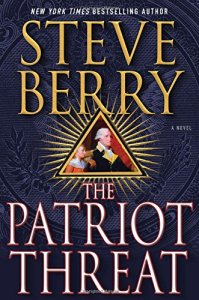
THE PATRIOT THREAT by Steve Berry

March 31, 2015
Click to purchase

Click to purchase

I fell in love with Steve Berry with his first book, The Amber Room, and many books later the love affair continues. I am delighted to help kick off his Blog Tour for his latest Cotton Malone thriller, The Patriot Threat. Read on for a review and an excerpt (and don’t forget to rush over & enter the ITW March Bookshelf of Thrillers contest to win a signed copy of this book plus several others – 3/31 is the last day to enter!)

REVIEW

by Paul Lane

The mantra that the only sure things in life are death and taxes is well known to everyone. Death is certain and taxes are always with us as a means of funding the government’s expenditures. The income tax that is law in the United States was approved as the 16th amendment to the Constitution and ratified by the requisite number of states needed to pass it. The implementation in 1913 was to only affect a few individuals that were perceived as able to pay it.

But with such an instrument in hand, the tax bite grew like Topsy, and it was President Franklin Roosevelt that initiated withholding at the payer source in order to collect quickly. Berry uses his character, Cotton Malone, a former secret agent known quite well to many readers, to tell the story.

While retired and living in Copenhagen where he owns a book shop, he does answer his previous supervisor Stephanie Nelle’s request to go after a rogue member of North Korea’s ruling family who is searching for information which can be used to damage the United States. The item is a crumpled sheet of paper that was handed to Roosevelt in 1933 by Andrew Mellon, a multi millionaire who had been named Secretary of the Treasury by three successive presidents and had an ongoing dislike for FDR.

Berry obviously has a great deal of dislike for Roosevelt and his politics. He postulates that Mellon told him to his face that he was a failure since he would need a war to end the great depression, which continued unabated until WWII. He is also accused of using the Internal Revenue Service as a gestapo to punish those who opposed him.

Mellon is described as hurling a paper at Roosevelt while arguing in private. This paper is described as pointing out the 16th amendment was not legally passed with several states not processing the proposal correctly. If so, it opens the United States to lawsuits halting the income tax and putting in claims for past payments made to the government. Since the Income Tax provides about 90% of America’s funding such an event would cause the country to default on it’s debts as well as not having the ability to function.

The rogue brother of North Korea’s current ruling family, Kim Yong Jin, is seeking the “crumpled” paper as a means of doing damage to the U.S., causing it to default on its debts. As a consequence he feels that he would be able to displace the current leader and take power.

The Patriot Threat, similarly to other Cotton Malone books, is a fast and engrossing read as clues and information are gathered and made sense of. It also makes use of information that Berry and his wife have gathered that is a bit out of the mainstream, and learned through their research in areas that they pursue due to their love of history. The book makes reference to events in other books about Cotton Malone, but is, like the others, a satisfying stand alone to be enjoyed even without the information that may seem to be missing.

EXCERPT

ONE

Cotton Malone dove to the floor as bullets peppered the glass wall. Thankfully the transparent panel, which separated one space from another floor-to-ceiling, did not shatter. He risked a look into the expansive secretarial area and spotted flashes of light through the semi-darkness, each burst emitted from the end of a short-barreled  weapon. The glass between him and the assailant was obviously extra-resistant, and he silently thanked someone’s foresight.

His options were limited.

He knew little about the geography of the building’s eighth floor— after all, this was his first visit. He’d come expecting to covertly observe a massive financial transaction—$20 million U.S. being stuffed into two large sacks destined for North  Korea. Instead the exchange had turned into a bloodbath, four men dead in an office not far away, their killer—an Asian man with short, dark hair and dressed as a security guard—now homing in on him.

He needed to take cover.

At least he was armed, toting his Magellan Billet–issued Beretta and two spare magazines. The ability to travel with a gun was one advantage that came with again carrying a badge for the United States Justice Department. He’d agreed to the temporary assignment as a way to take his mind off things in Copenhagen, and to earn some money since nowadays spy work paid well.

Think.

He was outgunned, but not outsmarted.

Control whats around you and you control the outcome.

He darted left down the corridor, across gritty terrazzo, just as another volley finally obliterated the glass wall. He passed a nook with a restroom door on either side and kept going. Farther on a maid’s cart sat unattended. He caught sight of a propped-open  door to a nearby office and spied a uniformed woman cowering in the dark interior.

He whispered in Italian, “Crawl under the desk and stay quiet.” She did as he commanded.

This civilian could be a problem. Collateral damage was the term used for them in Magellan Billet reports. He hated the description. More accurately they were somebody’s father, mother, brother, sister. Innocents, caught in the crossfire.

It would be only a few moments before the Asian appeared.

He  noticed another  office door and rushed inside the dark space. The usual furniture lay scattered. A second doorway led to an adjacent room, light spilling in through its half-open door. A quick glance inside that other space confirmed that the second room opened back to the hall.

That would work.

His nostrils detected the odor of cleaning solution, an open metal canister holding several gallons resting a few feet away. He also spotted a pack of cigarettes and a lighter on the maid’s cart.

Control whats around you.

He grabbed both, then tipped over the metal container.

Clear fluid gurgled onto the hall floor, spreading across the tile in a river that flowed in the direction from which the Asian would come.

He waited.

Five seconds later his attacker, leading with the automatic rifle, peered around a corner, surely wondering where his prey might be.

Malone lingered another few seconds so as to be seen. The rifle appeared.

He darted into the office. Bullets peppered the maid’s cart in deafening bursts. He flicked the lighter and ignited the cigarette pack. Paper, cellophane, and tobacco began to burn. One. Two. He tossed the burn- ing bundle out the door and into the clear film that sheathed the hall floor.

A swoosh and the cleaning liquid caught fire.

Movement in the second room confirmed what he’d thought would happen. The Asian had taken refuge there from the burning floor. Before his enemy could fully appreciate his dilemma Malone  plunged through the doorway, tackling the man to the ground.

The rifle clattered away.

His right hand clamped onto the man’s throat. But his opponent was strong.

And nimble.

They rolled, twice, colliding with a desk.

He told himself to keep his grip. But the Asian pivoted off the floor and catapulted him feetfirst into the air. His body hinged across his opponent’s head. He was thrust aside and the Asian sprang to his feet. He readied himself for a fight, but the “guard” fled the room.

He found his gun and approached the door, heart pounding, lungs heaving. Remnants of the liquid still smoldered on the floor. The hall was clear and wet footprints led away. He followed them. At a corner, he stopped and glanced around, seeing no one. He advanced toward the elevators and studied the transom, noticing that the position-indicator displays for both cars were lit 8—this floor. He pressed the up button and jumped back ready to fire.

The doors opened.

The right car was empty. The left held a bloodied corpse, dressed only in his underwear. The real guard, he assumed. He stared at the contorted face, obscured by two gaping wounds. Surely part of the plan was not only to eliminate all of the participants, but to leave no witnesses behind. He glanced inside the car and spotted a destroyed control panel. He checked the other car and found that it had also been disabled. The only way out now was the stairs.

He entered the stairwell and listened. Someone was climbing the risers toward the roof. He vaulted up as fast as caution advised, keeping an eye ahead for trouble.

A door opened, then closed.

At the top he found an exit and heard the distinct churn of a helicopter turbine starting from the other side.

He cracked open the door.

A chopper faced away, tail boom and fin close, its cabin pointing out to the night. The rotors began to wind fast and the Asian quickly loaded on the two large sacks of cash, then jumped inside.

Blades spun faster and the skids lifted from the roof. He pushed open the door.

A chilly wind buffeted him.

Should he fire? No. Let it fly away? He’d been sent only to observe, but things had gone wrong, so now he needed to earn his keep. He stuffed the pistol into his back pocket, buttoned  it shut, and ran. One leap and he grabbed hold of the rising skid.

The chopper powered out into the dark sky.

What a strange sensation, flying unprotected through the night. He clung tightly to the metal skid with both hands, the chopper’s airspeed making it increasingly difficult to hang on.

He stared down.

They were headed east, away from the mainland, toward the water and the islands. The location where the murders had occurred was on the Italian shore, a few hundred yards inland, a nondescript office building near Marco Polo International Airport. The lagoon itself was en- closed by thin strips of lighted coast joined in a wide arc to the mainland, Venice lying at the center.

The chopper banked right and increased speed.

He wrapped his right arm around the skid for a better hold.

Ahead he spied Venice, its towers and spires lit to the night. Beyond on all sides was blackness, signaling open water. Farther east was Lido, which fronted the Adriatic. His mind ticked off what lay below. To the north, ground lights betrayed the presence of Murano, then Burano and, farther on, Torcello. The islands lay embedded in the lagoon like sparkling trinkets. He curled himself around the skid and for the first time stared up into the cabin.

The “guard” eyed him.

The chopper veered left, apparently to see if the unwanted passenger could be dislodged. His body flew out, then whipped back, but he held tight and stared up once more into icy eyes. He saw the Asian slide open the hatch with his left hand, the rifle in his right. In the instant before rounds rained down at the skids, he swung across the undercarriage to- ward the other skid and jerked himself over.

Bullets smacked the left skid, disappearing down through the dark. He was now safe on the right side, but his hands ached from gravity’s pull. The chopper again rocked back and forth, tapping his last bits of strength. He hooked his left leg onto the skid, hugging the metal. The brisk air dried his throat, making breathing difficult. He worked hard to build up saliva and relieve the parching.

He needed to do something and fast.

He studied the whirling rotors, blades beating the air, the staccato of the turbine deafening. On  the roof he’d hesitated, but now there ap- peared to be no choice. He held on tight with his legs and left arm, then reached back and unbuttoned  his pant pocket. He stuffed in his right hand and removed the Beretta.

Only one way left to force the chopper down.

He fired three shots into the screaming turbine just below the rotor’s hub.

The engine sputtered.

Flames poured out of the air intake and exhaust pipe. Airspeed diminished. The nose went up in an effort to stay airborne.

He glanced down.

They were still a thousand feet up but rapidly losing altitude in some- thing of a controlled descent.

He could see an island ahead of them. Scattered glows defined its rectangular shape just north of Venice. He knew the place. Isola di San Michele. Nothing  there but a couple of churches and a huge cemetery where the dead had been buried since the time of Napoleon.

More sputtering.

A sudden backfire.

Thick smoke billowed from the exhaust, the scent of sulfur and burning oil sickening. The pilot was apparently trying to stabilize the descent, the craft jerking up and down, its control planes working hard.

They overtook the island flying close to the dome of its main church.

At twenty feet off the ground success seemed at hand. The chopper leveled, then hovered. Its turbine smoothed. Below was a dark spot, but he wondered how many stone markers might be waiting. Hard to see any- thing in the darkness. The chopper’s occupants surely knew they still had company. So why land? Just head back up and ditch their passenger from the air.

He should have shot the turbine a few times more. Now he had no choice.

So he let go of the skid.

He seemed to fall for the longest time, though if memory served him right a free-falling object fell at the rate of thirty-two feet per second, per second. Twenty feet equaled less than one second. He hoped that the ground was soft and he avoided stone.

He pounded legs-first, his knees collapsing to absorb the shock, then rebounding, sending him rolling. His left thigh instantly ached. Some- how he managed to hold on to the gun. He came to a stop and looked back up. The pilot had regained full control. The helicopter pitched up and maneuvered closer. A swing to the right and his attacker now had a clear view below. He  could probably limp off, but  he saw no good ground cover. He was in the open, amid the graves. The Asian saw his predicament, hovering less than  a hundred  feet away, the downwash from the blades stirring up loose topsoil. The helicopter’s hatch slid open and his attacker one-handedly took aim with the automatic rifle.

Malone propped himself up and aimed the pistol using both hands. There couldn’t be more than four rounds left in the magazine.

Make em count.

So he aimed at the engine.

The Asian gestured to the pilot for a retreat.

But not before Malone fired. One, two, three, four shots.

Hard to tell which bullet actually did the trick, but the turbine exploded, a brilliant fireball lighting the sky, flaming chunks cascading to the ground in a searing shower fifty yards away. In the sudden light he spotted hundreds of grave markers in tightly packed rows. He hugged the earth and shielded his head as the explosions continued, a heaping mass of twisted metal, flesh, and burning fuel erupting before him.

He stared at the carnage.

A crackle of flames consumed the helicopter, its occupants, and $20 million U.S. in cash.

Somebody was going to be pissed.


THE PATRIOT THREAT by Steve Berry. Minotaur Books (March 31, 2015). ISBN 978-1250056238. 400p.


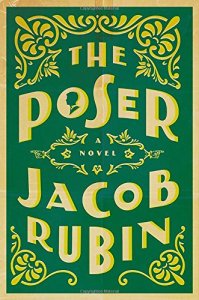
Guest Blogger: Jacob Rubin

March 17, 2015
Click to purchase

Click to purchase

Win a copy of Jacob Rubin’s caffeinated and wildly comic debut novel, which was recently selected a Barnes & Noble Discover Great New Writers pick for spring 2015 and named a one of Huffington Post’s 2015 Books We Can’t Wait to Read.
In the same vein as George Saunders and Sam Lipsyte, THE POSER chronicles the hijinks and crises of Giovanni Bernini, the World’s Greatest Impressionist—a man whose bizarre compulsion and ability to imitate anyone he meets catapults him from small-town obscurity to widespread fame. As he describes it, “No one disguise is perfect. There is in every person, no matter how graceful, a seam, a thread curling out of them. . . .  When pulled by the right hands, it will unravel the person entire.”

Honed by his theatrical mother at a young age, his talent eventually takes him from his hometown to the nightclubs of the City and eventually the sound stages of Fantasma Falls, the glamorous, west coast city similar to Hollywood. As Giovanni’s fame grows, he encounters a cast of provocative characters—including an exuberant manager, a mysterious chanteuse, an enigmatic psychoanalyst, and a deaf obsessive compulsive—and becomes increasingly trapped inside many personas. When his bizarre talent comes to define him, Giovanni is forced to assume the one identity he has never been able to master: his own.

At its heart, the novel speaks to the power of performance, impersonation, acting, and what it means to find and understand the essence of someone, and of yourself. I think author Sam Lipsyte nails it when he says Rubin “is a great hope for comic fiction in the 21st century.” Though THE POSER is his debut, it certainly announces the arrival of a new and unmistakable voice in American fiction.

Check out the Book Trailer

Q&A with Jacob Rubin, author of THE POSER

Giovanni Bernini, The Poser’s protagonist, is known as the World’s Greatest Impressionist. He’s born with the uncanny ability to imitate anyone he meets instantaneously. Throughout the literary spectrum, plenty of stories have been written about performers or performing, but not impressionists specifically. How did you conjure up such an interesting character?

The Poser began, oddly enough, in the trash. Years ago I was working on a not very good short story about a man who wakes up in a woman’s apartment after a one-night stand. Remembering little of the night before, he begins to root around in her garbage for clues. One of the items he finds was, to my surprise, a black-and-white photo of a famed impressionist, a man who could famously imitate anyone he met. As I soon discovered, I was much more interested in this unexpected performer than I was in the guy who discovered him. I scrapped the story right then and wrote another one, very quickly, about this character Giovanni Bernini. After many years, it became The Poser.

You have experience as a performer—both as a juggler for hire and as the lead rapper of the hip-hop group Witness Protection Program, opening for groups like Jurassic Five and Blackalicious, to name a few. How has your background as a performer influenced the creation of Giovanni Bernini?

I can’t seem to get away from performance, in life or in writing. Personae, masks, fraudulence, disguise—all have fascinated me for as long as I can remember. I think a lot about that Picasso line: that art is a “lie that tells the truth.” It seems to me this paradox can obtain in life, too. Like, I once read an article in the Times about a survivor of 9/11, a woman who had been in the south tower when the planes hit. After the tragedy, she organized these legendary support groups. They were these deeply cathartic events, arranged with great thought and care. Survivors and relatives of victims depended on her entirely, so strong was her empathy. Only later did it come out that this woman hadn’t been in the towers at all—she made the whole thing up. I find such behavior deeply disturbing, of course, but fascinating, too. The lie, for this woman at least, clearly felt like an emotional truth.

I did stand-up comedy for a little while, and I think the status of the stand-up comedian reflects a similar paradox: instead of a lie that tells the truth, maybe a stand-up states a truth so serious it has to be packaged as a joke. The stage offers a kind of loophole, a free zone in which what would otherwise be punishably inappropriate can be aired with impunity, even to applause. It’s what performance offers in general, I think: this magical, cordoned-off space where people can lie, hurl abuse, decompensate, and the crowd hoorahs! In The Poser, I wanted to explore a character who finds that his previously outrageous behavior is celebrated simply because it’s put on the stage.

A man with a million personas, Giovanni seemingly can be anyone except himself and at one point in the story undergoes psychoanalysis. Coming from a family of psychiatrists yourself, you must have some insight into analysis and some rather interesting stories, to boot. Will you talk briefly about growing up among psychoanalysts and how that may have shaped Giovanni as a character and the story as a whole?

My grandfather, Theodore Isaac Rubin, was a very famous psychiatrist in the 60s, 70s, and 80s. He appeared regularly on the Phil Donoghue show and wrote many bestselling novels and self-help books, one of which was turned into an Oscar-nominated movie, David and Lisa. Largely because of his influence, my father, aunt, and uncle all went on to become shrinks. Suffice it to say, there is no dearth of introspection at our family get-togethers. (Somewhat notoriously, I informed a classmate of mine in the third grade that he was “projecting”; I am still living this down.) And yet I also wanted to show how beneficial therapy can be. I think portrayals of analysis in books and movies are often pretty lazy, framing it as this ridiculous or masturbatory exercise. I wanted to show that there is true empathy in it – a kind of warm detachment – that can really help people.

The Poser is told from Giovanni’s perspective, at a point in his life where he’s looking back at everything that’s befallen him. What compelled you to use first-person confession as the mode for telling the story?

The enjoinder to “show don’t tell” is important for every young writer to hear, and yet so many of my favorite books wholly disregard it. Notes from the Underground, for instance, or Walker Percy’s The Moviegoer, the novels of Robertson Davies and Stanley Elkin. Everyone knows novels can’t compete with movies or video games for sheer sensory onslaught, but books, for my money, capture better than any other media the interiority of experience, the “music of someone’s intelligence,” as Richard Ford once put it. My favorite books promise just this kind of intimate—and for that reason, often scandalous—experience. Like, Lolita or Denis Johnson’s Jesus’s Son. You open those books, and you’re encountering this presence, this personality talking about something it shouldn’t have done in a voice unlike any you’ve ever heard. My favorite books, probably for that reason, feel like a secret, and you feel slightly cheated when you find out someone else read it. You’re like, “Hands off. She told that to me and no one else.”

Thematically, I thought the first-person narrative was necessary for The Poser as it’s about a man struggling to find himself, which he does, in the end, by telling the story. I also liked the tension of having someone act a certain way, as a performer or fraud, while narrating his often discordant internal experience. He says one thing, but thinks another. This is something I think fiction can do particularly well.

Giovanni’s world is noir-ish, vaudevillian, even a bit surreal. The story is set in an imaginary country that somewhat resembles America of the 1950s and 60s. What was your thought process in setting the story in a parallel, fable-like world?  Did you do any research to flesh out its wonderful detail?

I knew I was taking a risk in setting the book in an imaginary place, a parallel America of the 50s and 60s, and yet it felt necessary for the kind of book I was hoping to write. The Poser, as I see it, is about Giovanni’s attempt to become a real person; it felt right that the landscape, too, might strain to be real, flickering between the evoked and the shadowy. I did do research about the corresponding time in America. Stuff about clothes, some slang, etc. I used as models for the noir prose style novels by favorites like Jim Thompson and Raymond Chandler.

I can’t seem to escape the surreal. In visual art, it’s always been my favorite: Giacometti’s sculptures, for instance, or the paintings of Paul Klee. I think I’ve always aspired to whatever the prose equivalent of such a way of seeing would be. For me, it is rare that when meeting a person I note what color nail polish she’s wearing or which kind of ankle boot (this can be very embarrassing, mind you, for someone meant to be observant). Encountering a person can be a pretty damn surreal experience, much more like meeting a Giacometti or a Klee. I think the same is true of places. Just walking around and seeing people yammering on their cellphones or driving around in these motorized chrome bubbles—we live in a sci-fi movie! My agent, Jin Auh, once relayed a line the author George Garrett had about Fellini’s movies. He called them “science fiction set in the past.” I loved that. I think that’s what I’m trying to write.

Bestselling author Sam Lipsyte praised you as “a great hope for comic fiction in the 21st century.” Did you set out to write a humorous book? Were there any books or authors—comedic or otherwise—who inspired you while writing The Poser?

Sam Lipsyte has made me laugh so many times, so I was on cloud nine when I found out he enjoyed the book. I certainly hope the novel’s funny. My old teacher Barry Hannah used to say that books should offer “deep entertainment”; the unkillable ham in me can’t seem to let go of the second word. All of my favorite contemporary writers make me laugh: Jennifer Egan, Jonathan Lethem, Sam Lipsyte, Barry. Even very dark, supposedly depressing, classics are secretly knee-slappers. I’m thinking of writers like Knut Hamsun, Thomas Bernhard, Samuel Beckett, and Herman Melville. I read Paul Auster’s introduction to Hunger, in which Auster talks about how dark and miserable the book is (all of which is true, of course), but I also thought, it’s hilarious! The truly tragic is the funniest stuff there is! The fact that we live on a spinning ball in an endless void, or that we possess a seemingly infinite consciousness but will all die. It’s just so absurd. I think laugher is the sound of someone accepting their powerlessness and through that acceptance briefly somehow transcending it. And it shouldn’t ever be explained. And I now ruined it forever.

Besides working as a novelist, a magician, and a rapper, you also write screenplays. In fact, Times Square, a script you co-wrote with Taylor Materne, was recently optioned by Focus Features. In your opinion, what’s the biggest difference between writing a novel and a script, and do you prefer writing one form over the other?

I’ve found the two to be very different. In film, structure is king, so you really have to work out the entire plot as much as you can before setting off to write. It helps a lot to work with someone else to figure out what needs to happen when.  Of course, you often end up changing nearly everything anyway, but it’s almost more like assembling a watch or engine, some device that has to meet company-mandated specs. Fiction writing, for me, is a much more unwieldy, inefficient, foolhardy, and reliably meaningful experience. That said, I’ve always enjoyed writing dialogue, and the script stuff is a fun opportunity to pen snappy exchanges. In movie writing, you get to put down things like, “NO WAY OUT. The green creature on his heels, he GRABS the duffel bag and – screw it – LEAPS OFF the roof over the sea wall to the CHURNING WATERS of the GULF of MEXICO.”

The Poser is your debut novel. Is there a second in the works? If so, could you talk a bit about it? If not, would you mind divulging what other creative projects you’re currently working on?

There is a lengthy word file in my laptop that I hesitate to call a second novel, but perhaps it will be one day! It is too early to talk about it, but I hope it will be funny.

To win your own copy, please send an email to contest@gmail.com with “WIN POSER” as the subject.

You must include your snail mail address in your email.

All entries must be received by March 31, 2015. Two (2) names will be drawn from all qualified entries and notified via email. This contest is open to all adults over 18 years of age in the United States only. Your book will be sent by the publisher, Viking Press.

One entry per email address. Subscribers to the monthly newsletter earn an extra entry into every contest. Follow this blog to earn another entry into every contest. Winners may win only one time per year (365 days) for contests with prizes of more than one book. Your email address will not be shared or sold to anyone.

3/15 Stacy Alesi, AKA the BookBitch

THE POSER by Jacob Rubin. Viking (March 17, 2015). ISBN 978-0670016761. 256p.


Guest Bloggers: David & Veronica James

March 6, 2015

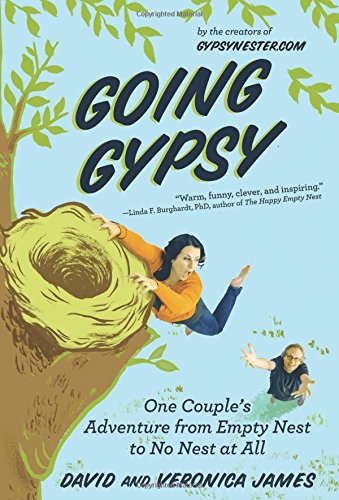
GoingGypsyGOING GYPSY: One Couple’s Adventure from Empty Nest to No Nest at All

Almost every couple faces a “now what?” moment as their last kid moves out of the house. There’s a big empty nest looming over this new and uncertain stage in their lives.

David and Veronica James chose to look at this next phase of life as a beginning instead of an ending. Rather than staying put and facing the constant reminders of empty bedrooms and backseats, a plan began to develop to sell the nest and hit the highway. But could a homebody helicopter mom learn to let go of her heartstrings and house keys all at once?

Filled with a sense of adventure and humor, GOING GYPSY is the story of a life after raising kids that is a celebration of new experiences. Pulling the rip cord on the daily grind, David and Veronica throw caution to the wind, quit their jobs, sell their house, put on their vagabond shoes, and go gypsy in a beat-up old RV found on eBay.

On a journey of over ten thousand miles along the back roads of America (and a hysterical, error-infused side trip into Italy), they conquer old fears, see new sights, reestablish bonds with family and friends, and transform their relationships with their three grown children from parent-child to adult-to-adult. Most importantly, they rediscover in themselves the fun-loving youngsters who fell in love three decades prior.

For more about the book: http://www.goinggypsybook.com/


Q&A with David & Veronica James

Authors of GOING GYPSY: One Couple’s Adventure from Empty Nest to No Nest at All

Most people become empty nesters when their kids leave home, but you left home too. How did that come about? 

David: We were living in the Virgin Islands and were a bit separated from all of our family and friends in the US. Once our youngest went off to college in the states, like his sisters before him, there was nothing keeping us in the Caribbean. So we decided to sell the house and take what we called a “victory lap,” celebrating a job well done—getting our kids raised and successfully out on their own.

Veronica: One of the reasons I had to resort to drastic measures was that I worked at the kids’ school. I was the quintessential “helicopter mom,” hovering over everything my kids did. The idea of going back to the school without the kids there was heartbreaking. So we whittled our belongings down to sixteen boxes and took off in a beat-up old RV we bought on eBay.

What was the process like from when you decided to take off to when you started your adventure? 

David: That’s what Going Gypsy is all about. We cover the year when our son left for college and we hit the road. We did not have this big plan in our heads at the start to live a gypsy lifestyle. It organically grew as we went along. Initially, we got the motor home as a way to take some time to visit with family and friends and see the country without going broke. Once we were out on the road a while, we realized how much we liked it and wanted to figure out how we could keep going. It’s been over six years now.

Veronica: A big thing that jolted us into thinking about a new approach to our lives was when we Googled “empty nest” and a big ad for an Alzheimer’s patch popped up. We thought, “holy cr-moley!” We have a good third of our lives left and that’s too long a time to be sitting around doing nothing. We see our book as a kick in the butt to get folks going and hopefully think outside the box.

How did you dispense with a lifetime’s worth of belongings? 

Veronica: The stress of a big move is huge no matter what the circumstances. We gave away or sold a lot of stuff, keeping only the things we knew we couldn’t live without (like photo albums and family heirlooms). Those we managed to fit into sixteen boxes that we put in storage. Now I find I’m more organized the less I have with me. If I have too many things and too much space to spread out in, I get really scattered and disorganized. 

How did you adjust to having “no nest at all?” 

David: We replaced our nest with one on wheels. The RV became our new home. It’s remarkable how homey it became and how quickly. It’s obviously very condensed, and we do travel light, but when you think about what you really need, we have the basics—a bed, a bathroom, a kitchen, and a table to sit at to eat and write.

Veronica: And the view out the window is different every day, which is fantastic!

How did your kids react to you leaving home? 

Veronica: Our son was horrified at first. I remember him saying, “you’re going to live in your car?!” But I think they’re happy for us. My guess is that they are also happy that Mom has things to do besides constantly bugging them about who they are dating or when they might make us grandparents. 

David: I imagine what they’re thinking is a mixture of relief and what the heck are they doing? But a big plus in this process has been developing a new relationship with our children as adults. We wanted to make an adult-to-adult connection and not be helicopter parents any longer. 

Don’t you miss seeing your kids regularly? 

David: We see the kids more than we would have if we’d stayed in St. Croix because we can route ourselves through wherever they are on our way from one adventure to the next.

Veronica: Our daughters live in Manhattan so they are easy to see often. Our son is in Alaska but he is a pilot and has the flying privileges that come with that, so it is usually easier for him to meet up with us.

How do you handle holidays?

David: Our oldest daughter took over the hostess role fairly quickly, as soon as we didn’t have the house any longer. She’s not one to miss out on the holiday treats and I guess she knew that it’s nearly impossible to shove a turkey into a motor home oven!

Veronica: She has done a remarkable job. New York City is an amazing place to spend the holidays. It’s very festive. So everyone is happy.

Was making this leap more exciting or scary? 

David: I am a musician so I always traveled a lot and I love it. It was natural for me to explore. For Veronica it was more of a drastic change.

Veronica: The hardest part was the initial decision to make the leap. I was a homebody—I didn’t think I’d be able to do it. But I’m proactive, and a planner, so it was good for me to be able to throw myself into the planning phase. I did have to do quite a bit of fear conquering. I guess I just transferred the fear—now I’m more scared to stop moving than I was to start in the first place!

How many places have you visited? 

David: We started in the RV by exploring the US, and then branched out to Mexico and Canada, following the weather like geese. As time went on, we broadened our horizons and added some traveling by air and sea. Now I think we’ve been to over 40 countries on five continents. Later this year we’re heading to Africa, making six out of seven, then our final continent will be Antarctica. We’ll get there!

Veronica: David has also been to all 50 states but I’ve only been to 48, so I need to cover my last two—Alaska and Hawaii. We’re very competitive so I can’t stand him being ahead of me.

What have been the highlights so far? 

Veronica: There are so many amazing high points. But I think the Galapagos Islands were up there at the top. I love animals; I’m like a little kid around them. The islands have so many unique species, and they are completely unafraid of humans, so if you love animals put the Galapagos at the top of your bucket list.

David: I answer this question different each time it’s asked because I have so many favorites. Walking along the top of the Great Wall of China was a real highlight. But I could easily name dozens more.

What have been the low points? 

Veronica: Yikes. Well, I locked myself inside a hotel room in Italy once. But a big one came when we had a blowout over our traveling styles. We had discussed the empty nest and all that it entailed, but forgot discuss to how we liked to travel. It ended up coming to a head in one of the most beautiful places in the world, Yellowstone National Park, in the middle of a herd of buffalo.

David: I have a go-go-go mindset. I always want to be moving forward. Veronica likes to really get a feel for a place and connect to it. In the end, I learned to adapt more to her style because it is a better way to see the world. 

Veronica: I call him a wham-bam-thank-you-ma’am traveler.

Have you inspired others to travel? 

Veronica: I hope so. My favorite part of this journey so far has been hearing from folks who chose places because we said how much we loved them. But there are so many wonderful things people in our life phase can do if they aren’t interested in travel, you don’t have to be as crazy as we are to start going gypsy. Do that thing that inspires you, something that you’ve always wanted to explore. Write that book, volunteer in your community, go back to school. And don’t forget to reconnect with your partner, do new things together, and find that pre-kid couple who fell in love all those years ago. We are not self-help writers. We haven’t written a how-to guide. We just aspire to be the same kind of kick in the butt for our readers that we found when we first saw that ad for the Alzheimer’s patch.

David: We try to seek out the unexpected, and discover overlooked gems in our travels. Sometimes they are found in famous, bucket-list type destinations; often they are hiding well off the beaten path. Either way we enjoy relaying stories from out of the ordinary. Hopefully that inspires some people to venture down the road less traveled too.

How have you pushed yourselves? 

Veronica: I made a decision to fear-conquer my butt off. As a mom I developed so many fears and it turned into a vicious cycle. I purposefully inserted myself into situations to overcome these fears. Just to name a few, I’ve paraglided off of the seacliffs in Lima, Peru, shot the rapids in Montana, and ziplined over a 300-foot waterfall in Newfoundland—I even went to roller derby camp; it took three days in bed to recover from that little escapade!

David: Veronica was all gung-ho about jumping out of an airplane in Australia. I see no need to abandon a functioning aircraft unless it is on fire. But once she threw down the gauntlet I accepted the challenge. Halfway up our attitudes had done a complete 180—she was looking pretty puny, scared to death, and I was excited at the prospect of freefalling from ten thousand feet.

Have you eaten any strange foods? 

David: Tons. We write about that a lot on our blog. I’m not sure if they were the strangest, but the worst by far was silkworms in China. For one thing, the smell made it nearly impossible to eat them. Oh, and the fact that they are bugs.

Veronica: A little clarification here, I ate silkworms, David spit his out. I won that one.

David: Let me just go on the record here: while I admit to spitting out the vile worm, I did eat a bug in Mexico, a cricket to be exact, and it was about a million times better than the silkworms.

Veronica: Yes, he did finally lose his bug virginity.

What’s next for the Gypsy Nesters? 

Veronica: The more we travel the more we want to see; we’ve turned into very greedy travelers! We’d love to get to New Zealand. And we haven’t been to Scotland—we both have roots there—so we feel a huge pull to visit. I could name several dozen more… but you really don’t want me to pull out the whole list, do you?

David: When we started out we had a saying: the plan is no plans. We like to leave life open to reveal itself to us so we usually don’t know where we will be too far in advance. We have a river cruise coming up through Holland and Belgium, and we are going to Africa this summer, but beyond that we will see where the wind takes us. In the meantime, we are working on a second book that will cover our adventures after that first year of taking our initial leap into the life of Going Gypsy.

About the Authors, by the authors:
David James was born in Wichita, Kansas, and grew up on the prairie and in the mountains of Colorado. He made his way in the music business as a performer, recording artist, songwriter, and radio personality in Nashville, Tennessee, and St. Croix, US Virgin Islands. After parenting and sending three kids out into the big wide world, he currently lives with his bride of thirty years, Veronica, in a state of perpetual motion. The couple writes about their travels since becoming empty nesters on their popular website, GypsyNester.com.

Veronica James was born and raised in Southern California and was like, totally, a Valley Girl. Against any sane person’s better judgment, she ran off with a musician at age eighteen. After procreating, she became Earth Mama, then Helicopter Mom, hovering over every detail of her children’s lives. Veronica has held approximately thirty-three different jobs including writer. She is never bored.


Guest Blogger: Peter Swanson

February 18, 2015

Kind Worth Killing

I am excited to welcome guest blogger Peter Swanson – and be sure to read on to the end to find out how you can win a copy of The Kind Worth Killing!

In this piece Peter Swanson, author of The Kind Worth Killing, shares some advice for BookBitch readers who may be writers or aspiring writers.

Book Release Day by Peter Swanson

My second novel was just published at the beginning of this year, and to be honest, release day for book two was more nerve-wracking than release day for my debut novel. I think that when my first book, The Girl with a Clock for a Heart, came out at the beginning of 2014, I was far too excited to be that nervous. I also had zero expectations. I had one goal in my writing life—to publish a novel—and it had just happened.

But this year it felt a little different. More anticipation, somehow. More hope. Also, your goals change. I am now hoping to publish more than two books, and it seems important that I secure some good reviews, plus some decent sale numbers, to make that happen. Hence, the nerves.

But here’s the thing about Book Release Day. There’s nothing you can really do about it. You’ve already done your work and the book, for better or for worse, is out there. I suppose you can check out twitter for people mentioning you, and then thank them for the mentions, but that’s about it. If you live near a bookstore, you can go there and sign copies (if they have them), and bring the booksellers doughnuts.

What I recommend is that you have a few drinks (alone or with company) at your favorite local bar or restaurant. And do it without a laptop or a smart phone handy. Sometimes it’s nice just to celebrate the day without looking to see if you’re getting any comments on twitter, or blog reviews. Just be in the moment. Your book is out in the world.

Then, when you’re done celebrating, go and start work on your next book.

About The Kind Worth Killing

On a night flight from London to Boston, Ted Severson meets the stunning and mysterious Lily Kintner. Sharing one too many martinis, the strangers begin to play a game of truth, revealing very intimate details about themselves. Ted talks about his marriage that’s going stale and his wife Miranda, who he’s sure is cheating on him. Ted and his wife were a mismatch from the start—he the rich businessman, she the artistic free spirit—a contrast that once inflamed their passion, but has now become a cliché.

But their game turns a little darker when Ted jokes that he could kill Miranda for what she’s done. Lily, without missing a beat, says calmly, “I’d like to help.” After all, some people are the kind worth killing, like a lying, stinking, cheating spouse. . . .

Back in Boston, Ted and Lily’s twisted bond grows stronger as they begin to plot Miranda’s demise. But there are a few things about Lily’s past that she hasn’t shared with Ted, namely her experience in the art and craft of murder, a journey that began in her very precocious youth.

Suddenly these co-conspirators are embroiled in a chilling game of cat-and-mouse, one they both cannot survive . . . with a shrewd and very determined detective on their tail.

About Peter Swanson

Peter Swanson PhotoPeter Swanson is the author of two novels, The Girl with a Clock for a Heart, and The Kind Worth Killing, available from William Morrow in the United States and Faber & Faber in the United Kingdom. His poems, stories and reviews have appeared in such journals as The Atlantic, Asimov’s Science Fiction, Epoch, Measure, Notre Dame Review, Soundings East, and The Vocabula Review. He has won awards in poetry from The Lyric and Yankee Magazine, and is currently completing a sonnet sequence on all 53 of Alfred Hitchcock’s films. He lives with his wife and cat in Somerville, Massachusetts. Read more and find links to social media profiles at: http://www.peter-swanson.com.

To win your own copy, please send an email to contest@gmail.com with “WIN THE KIND WORTH KILLING” as the subject.

You must include your snail mail address in your email.

All entries must be received by February 28, 2015. Two (2) names will be drawn from all qualified entries and notified via email. This contest is open to all adults over 18 years of age in the United States or Canada. Your book will be sent by the publicist.

One entry per email address. Subscribers to the monthly newsletter earn an extra entry into every contest. Follow this blog to earn another entry into every contest. Winners may win only one time per year (365 days) for contests with prizes of more than one book. Your email address will not be shared or sold to anyone.


Guest Blogger: D.J. Donaldson

January 27, 2015

Click to purchase

Nursery Rhymes and Murder-Suicides Haunt New Orleans

Black magic releases ancient curse in the Big Easy

“Action-packed, cleverly plotted topnotch thriller. Another fine entry in a consistently outstanding series.” –Booklist

 “D. J. Donaldson is superb at spinning medical fact into gripping suspense. With his in-depth knowledge of science and medicine, he is one of very few authors who can write with convincing authority.” –Tess Gerritsen, NY Times bestselling author of the Rizzoli & Isles novels

 Andy Broussard, the “Plump and Proud” New Orleans medical examiner, obviously loves food.  Less apparent to the casual observer is his hatred of murderers. Together with his gorgeous sidekick, psychologist Kit Franklyn, Broussard forms a powerful, although improbable, mystery solving duo.

 Astor + Blue Editions is proud to release Cajun Nights (ISBN: 978-1941286-38-8; Fiction/Mystery & Suspense; $5.99 E-Book), the latest Broussard mystery by D.J. Donaldson. 

Young and vibrant New Orleans criminal psychologist Kit Franklyn has just been assigned her most challenging case yet—a collection of victims with type O blood who drove an antiquated car, humming a nursery rhyme right before committing murder and then suicide. Welcoming the help of her jovial boss, chief medical examiner Andy Broussard, the two set out to solve the case devising strictly scientific possibilities. Not once do they consider the involvement of black magic until an ancient Cajun sorcerer’s curse surfaces—“Beware the songs you loved in youth.”

Written in his unique style, Donaldson’s Cajun Nights combines hard-hitting, action-packed prose with brilliant first-hand knowledge of forensics and the sultry flavor of New Orleans. The result is a gripping mystery involving murder and some occult flare in the creole heartland.

CAJUN NIGHTS AND THE CHARACTERS WITHIN:

THE MANY LIVES OF A TV SERIES THAT NEVER WAS

by D.J. Donaldson

LIFE #1

Cajun Nights was my first novel featuring New Orleans medical examiner, Andy Broussard, and his suicide/death investigator, Kit Franklyn.  A few weeks after the book was published, I got a call from my agent with the surprising news that, “There’s been a flurry of movie and TV interest in your book.”  I’d never considered that such a thing was possible. So that was one of the best phone calls I ever had.

Subsequently, a production company headed by the former director of programming at CBS took an option on the series, planning to shape it into a TV show.  As perhaps some of you know, this phase of things is known as “development hell”, because it takes a very long time to make anything happen. So a year went by with no news.  I figure, okay, the thing is dead.  But, the producers renewed their option for another year, which meant I got paid again.  It wasn’t a lot of money, but with that check, I’d made more money from the two option years than the advance I was given on the book by the publisher.

So more time goes by with no news.  Now, I’m not even thinking about it anymore. Then, while I was attending a scientific meeting in Dallas, I got a call from the agent in Hollywood who was handling the dramatic rights.  CBS had agreed to pay for a pilot screenplay. I wasn’t sure what that meant, but if this guy had tracked me down in Dallas just to tell me that, it must be a big deal.  And guess what… I got another check as an advance on the screenplay even though I wasn’t gonna write it.  I was beginning to love the agent who created that contract.

They chose as a writer someone who’d had several movies produced.  That may seem like something not worth mentioning, but I’d read an article once that said it was possible to have a career as a screenwriter and never have anything produced.  (Yeah, I don’t quite get that either, but it sure seemed like the writer we had, was the better kind.) With her experience and success, I was sure we’d get a great screenplay.

 A few months later, a package arrives in the mail.  IT’S THE SCREENPLAY.  I’m so excited, I quickly skim the enclosed letter from the producers: “Read this over and tell us three things you don’t like about it.”  That’s ridiculous, I’m gonna love it.  After all, it was written by a pro.

Well, I hated all of it.  The writer didn’t seem to “get” the relationship between Andy and Kit.  I couldn’t believe it.  The books show that non-romantic love is possible between an unrelated man and woman of greatly differing ages. Though he can’t admit it, Broussard loves Kit like the daughter he never had.  Kit loves Broussard like a father, even though she has a father.  How do I boil all the things I hate down to just three items? Somehow I manage and send my reply back.

As it turned out, the producers didn’t really care about any of my thoughts.  Was I upset?  Not really, because I figured they know TV, I don’t.  And… surprise, when they gave the script to CBS, I got another check.  Now I definitely love my agent.

The producers are sure the script will be approved and we’ll soon be shooting a pilot.  They invite me to watch them film in New Orleans.  They say they’ll even find a bit part for me.  They predict that the series will run for ten years. And they should know. Their show, Cagney and Lacey, ran for seven seasons. Now I’m excited.

But… later, I get another call.  CBS didn’t like the script. And they didn’t want to see a rewrite with the same story. The producers asked me if I had any ideas.  The screenplay was based on the second book in the series. When I got this call I was sitting at my desk looking at the rough draft of book number three.  I pitched them the story and they said, “Send us a copy by overnight mail.” This was back before manuscripts could be sent by e-mail. (I know, I can hardly remember those days myself.)

So another screenplay was written, which didn’t fare any better than the first. Thus life #1 of my hoped-for TV series went to a quiet demise.

LIFE #2

 A few years later, while I was at the Kentucky book fair promoting book number five in the series, a young blonde fellow bought a book.  We spoke for a few minutes and he moved on.  Later, back in Memphis, I get a call from this guy.  He wants to option the series for TV.  I tell him about my earlier experience with the other producers, who failed, but he’s unfazed.  We strike a deal. There’s talk about John Goodman playing Broussard.  John Goodman… he lives in New Orleans and he’d be a great fit.  I love it.

Within a few weeks the producer calls to say he’s on his way to Memphis and could I meet him and John Goodman’s “best friend,” at the Peabody Hotel.  (The Peabody lobby is where William Faulkner and his mistress used to have drinks.)  The meeting takes place and I give the best friend a copy of the latest book, which he assures us, will be in John Goodman’s hands within twenty-four hours. That was the last time I ever heard from him or the producer.  So I guess the deal is off.

LIFE #3

In my primary occupation, I taught medical and dental students microscopic anatomy.  One day I get a call from a former dental student.  He’s now a part-time actor who’s been in a couple of notable films.  He says that he and a long-time Hollywood promoter have formed a production company and are looking for material. He remembers that I wrote a few novels and wonders what I’ve been doing since he last saw me. I talk about my work and send him some books.

Very soon thereafter he calls me again and says he and his partner “are on fire over these forensic books.”  They believe the series would make a great TV SERIES.  He asks me who I’d like to play Broussard.  I tell him I’ve always believed Wilford Brimley would be perfect.  Incredibly, my former student says that his partner had lunch with Wilford just last week.  He’s sure they can get him to sign on.  With an actor of Wilford’s stature attached to the project, we’ll surely get a deal.

Was all this talk about Brimley just smoke?  No.  Because they actually got him on board.  And what’s even better, my former student and his partner were working with another producer who had a development deal with the Sci-Fi network.  They planned to present my series to the network three weeks hence, focusing on the real and apparent paranormal aspects of the first two books.

On presentation day at the Sci-Fi Network my student calls me just before they go in.  I wait anxiously the rest of the day to hear how it went.  Years later, I’m still waiting.  The only contact I’ve had since presentation day is a big envelope from the producer who had the development deal.  In the envelope is a bunch of stuff I wrote for the presentation along with a note from the producer that says, “Sorry we couldn’t have worked longer on this together.”

LESSON LEARNED

Early in the machinations of the first development deal, I used to caution myself not to spend any time thinking about how great it would be if every week I could watch my characters living and breathing on a TV show.  My thinking was that if I kept a tight rein on my expectations, it’d be much easier on my psyche if things didn’t work out.

But then I realized I was missing out on the excitement of the possibility.  Why not let my mind run with it?  Then, even if none of the deals came to fruition I would still have the pleasure of being part of a great endeavor.  So that’s what I did.  And now, even though I never played that bit part in a pilot and I’ve never seen John Goodman or Wilford Brimley bring Broussard to life, I sure had a lot of fun along the way.

(By the way, if you’re a TV/film producer, the rights are available.)


ABOUT THE AUTHOR

D.J. Donaldson is a retired professor of Anatomy and Neurobiology.  His entire academic career was spent at the University of Tennessee, Health Science Center, where he published dozens of papers on wound-healing and where he taught microscopic anatomy to thousands of medical and dental students.

He is also the author of seven published forensic mysteries and five medical thrillers. He lives in Memphis, Tennessee with his wife and two West Highland terriers. In the spring of most years he simply cannot stop buying new flowers and other plants for the couple’s prized backyard garden.


Guest Blogger: Alan Wyler

November 24, 2014

Click to purchase

Sin City’s Deadliest Game

Young “Dark Net” Hacker the Unlikely Key to 9/11-Style Terror Plot 

“Deadly Odds is original, and a first rate thriller.”

–Philip Margolin, NY Times bestselling author of Woman with a Gun

“Allen Wyler knows of what he speaks, and writes, and the result is a thriller that equals and updates the best of Robin Cook and Michael Crichton.”

Jon Land, bestselling author of Strong at the Break

“A wild Journey… you won’t be able to put it down.”

D.P. Lyle, award-winning author of, Hot Lights, Cold Steel. 

Astor + Blue Editions is proud to present Deadly Odds (ISBN: 978-1-941286-02-9; Fiction, Thriller, Suspense & Crime, Technological Fiction; Espionage; September, 2014), a new breakout suspense thriller with a “techno edge” by bestselling author Allen Wyler. What happens when a shy and awkward young computer hacker has a run-in with terrorists?   

Twenty-three year old Arnold Gold is a local computer genius in his native Seattle, described as a “part-time hacker and full-time virgin” by his friends. When the awkward young shut-in decides to take matters in his own hands, and venture to Vegas “to get lucky,” little does he know that his hacking skill will make him  a bull’s-eye target for terrorists and the FBI.

A major terrorist group wants Arnold’s “Dark Net Hacking” system to help hatch their latest plot, and they’ll stop at nothing to claim it—even killing Arnold’s friends. Now, with murderous terrorists, the FBI, and the local cops on his tail, Arnold finds himself trapped in a high-stakes game with the odds of survival slim to none. It will take every last bit of his genius intellect and legendary hacking skill to stay one step ahead of the deadly game, and foil the plot that will turn Sin City into the scene of the deadliest terror attacks since 9/11.

Written in Allen Wyler’s break neck style and attention to expert detail, Deadly Odds is as terrifyingly plausible as it is darkly humorous and enjoyable. The riveting story of a young man who lives life through his computer and discovers its dark side is sure to win him legions of new fans. Filled with suspenseful twists and enough technological detail to keep both techno-thriller and classic suspense fans on the edge of their seats, Deadly Odds is the ultimate thrill ride for the emerging tech-savvy generation.

Q&A with Alan Wyler

Q:  How did you come up with the idea of the story?

A:  The first novel I ever wrote was based on this story’s kernel: a geek who develops a strategy to successfully gamble draws unwanted attention to himself. But that novel turned out to be disaster and was rejected by every agent I queried. However, the idea of being able to beat the odds remained intriguing yet elusive. Then one day I read about Nate Silver and his uncannily ability to accurately predict various phenomenon based on statistics. After all, this was what the 2011 Brad Pitt movie Moneyball was based on. Once I read about Silver, I knew the plot was much more believable.

Q: What influenced you to create a computer hacker protagonist than the usual medical professional?

A: There are several reasons. First, I don’t like being pigeonholed into the subgenre of “medical thriller.” In addition, it’s unbelievable to believe that a healthcare professional would have the computer expertise—or time—to pull off something like Arnold Gold does. More importantly, in doing my research for this story, I became fascinated with the Darknet and Internet security. I really wanted a way to weave this interesting information into a compelling story. So… a likeable computer hacker seemed to be a much more interesting character to develop than another neurosurgeon. I love Arnold Gold’s character and a really glad I settled on him.

Q:  Why Vegas? Have you always wanted to write a book with Sin City as the setting?

A:  When first developing the story I didn’t have any city in mind other than I knew Arnold lived in Seattle. (I love the city as a backdrop to stories.) I also knew Arnold wanted to get laid but was so uneasy about seeing an “escort” for this purpose, that it made sense for him to go someplace far from home where he’d be unlikely to run into anyone he knew. Given the reputation of Sin City, it just felt right to send him there.

Q:  Do you plan on writing more thriller books outside of the medical thriller genre?

A:  You bet. I like exploring topics dealing with computers and the Internet. I’m especially intrigued with hacking and the Darknet. My next book, Cutter’s Trial, however, is not a thriller and lands me right back in the medical arena because it explores the issue of physician assisted suicide. Having been involved in a couple start-up companies, I’m also toying with using that subject as a basis for a book, but I have nothing in development along these lines at the present time. We’ll see what happens.

Q:  Would you ever consider a sequel to this book?

A:  Glad you asked the question. Both Arnold Gold and Palmer Davidson are such wonderfully rich characters that Robert Astle (my agent) and I agree they are well-suited for a sequel. At the moment I’m busy writing Deadly Odds 2.0.

Q:  Do you think this book could be a movie? Who could you picture playing Arnold?

A:  Of all my prior thrillers, I think this one has the most cinematic potential. I’m lousy at casting, so if it were ever made into a movie (my wildest dream), I’d leave that choice to the producers.

About the Author

Allen Wyler is a renowned neurosurgeon who earned an international reputation for pioneering surgical techniques to record brain activity.  He has served on the faculties of both the University of Washington and the University of Tennessee, and in 1992 was recruited by the prestigious Swedish Medical Center to develop a neuroscience institute.

In 2002, he left active practice to become Medical Director for a startup med-tech company (that went public in 2006) and he now chairs the Institutional Review Board of a major medical center in the Pacific Northwest.

Leveraging a love for thrillers since the early 70’s, Wyler devoted himself to fiction writing in earnest, eventually serving as Vice President of the International Thriller Writers organization for several years. After publishing his first two medical thrillers Deadly Errors (2005) and Dead Head (2007), he officially retired from medicine to devote himself to writing full time.

He and his wife, Lily, divide their time between Seattle and the San Juan Islands.

www.allenwyler.com


Amazon:  http://goo.gl/jtr0IQ

B&N: http://bit.ly/1sZrIy1

Apple:  http://bit.ly/1xU0YiA

Kobo:  http://bit.ly/1vo7n6Y


Guest Blogger: Karen Chase

October 9, 2014

Click to purchase

Today’s guest blogger is Karen Chase, whose book, Polio Boulevard, is a short, sweet, and powerful memoir about surviving polio. It’s super timely given the anniversary of the Salk vaccine, all the current Roosevelt coverage, and (unfortunately) with polio back in the news as a threat again.
Q&A with Karen Chase

Sixty years after your childhood polio diagnosis and after a long, successful career as an author of poems, stories and essays, why did you finally decide to write your memoir, POLIO BOULEVARD?

While my childhood was marred by the disease and its recovery, I did not consciously think of myself as a polio survivor. For many decades, I never looked back. My polio became a distant memory. I suppose it has taken me this long to write about it because, for some people, personal stories take a long time to tell.  Although I didn’t experience my illness as traumatic, no doubt it was.  Maybe I repressed the story.  For some reason, it never popped up as something to talk or write about.  Art being what it is – art emerges from the soul – it suddenly loomed large as a subject to explore in my writing.  I don’t question this process.  I just tag along, following the muse.

What was your childhood like prior to your polio diagnosis?

I was a sprouting ten-year-old girl living in an affluent suburb of New York City, and all was well. I was merrily jumping rope and playing hopscotch with my friends.  I’d hop on my bike and help my older brother deliver newspapers up and down the streets of my town. I’d swim in Long Island Sound, a short bike ride from our house. And I had a new baby sister!  I was in fifth grade. One day while walking home from school for lunch, kicking a stone down the road, my legs began to hurt. After a peanut butter and jelly sandwich and glass of cold milk, I said, “Mom, I can’t go back to school today.” My neck got stiff, my fever rose alarmingly, and what started as small pains turned into large ones. The doctor came and soon I was rushed to the hospital in an ambulance, diagnosed with polio.

What was the recovery process like?

I spent 6 months in Sunshine Cottage, the polio ward at Grasslands Hospital in Westchester County, NY.  During that time, I was in a wheelchair and had a back brace. Later, I was put in a full-length body cast, underwent a spinal fusion at the Hospital for Special Surgery in New York City. I left school in fifth grade upon my diagnosis and did not return until I was a high school freshman.

How did your rich imagination and creativity help you through your ordeal?

As a young girl, my mother took me on the train into New York City where I took painting lessons in the basement of the Metropolitan Museum. Right now, I can smell those oversized jars of red and blue tempera. I loved to paint. Polio struck when I was ten years old and I was shocked to be immobilized—first by the deadening effect of polio and later by an enormous body cast. As my body was losing motion, my mind was painting. I remember lying inert in my hospital bed, focused on the dots of the hospital ceiling tiles.  I pretended they were all kinds of animals on the move—bears, camels, foxes on parade. With the help of my abundant imagination, I joked around on the hospital ward, making life not only bearable but fun. Looking monster-like in my full-length body cast, I wrote a letter to the Barbizon School of Modeling, asking whether I could become a model. My illness made for a rich inner life and immobility shaped and widened my vision. After polio, I valued my mind’s flexibility like gold.

How did having polio as a child affect your sensory experiences and body image?

The way a blind person compensates for for lack of vision by exceptional hearing, I compensated for my immobility by always looking, looking, looking and always listening. Before I got sick, I was particularly tuned in to what I saw and heard.  Since then, this tendency has mushroomed. To this day, I react strongly to even the slightest sound, which can sometimes be difficult. When I hear friends talk about aging, how this or that attribute has changed, I realize how my polio has affected my body image. My body has been imperfect for as long as I can remember.  Seeing my body age is part of this ongoing imperfection so it is not jarring.  I don’t mean to sound like I don’t care what I look like – I’m actually quite vain.

What was your reaction to the news that Jonas Salk had invented the polio vaccine?

In the spring of 1954, when I was a patient in the polio ward at Grasslands Hospital in Westchester County, I was happily playing Monopoly with my friends.  The radio was on.  A voice announced that a doctor named Jonas Salk had invented a vaccine to prevent polio.  Some of us turned silent, some of us laughed, and one patient blurted out, “Too late for us!”  Here we were, a group of ill children on stretchers and in wheelchairs living through an historical moment when polio’s peril was replaced by joy and relief.

What has been your personal perspective over the years on Franklin Delano Roosevelt, a polio patient who became president of the United States?

For me and so many others who had polio, FDR is a figure alive in our imaginations. How helpful to know how he embraced life after his illness, how courageous he was, how he moved ahead in the world. Not only that, but the way he tirelessly worked and fought for those less fortunate is inspiring, especially in today’s climate.  Additionally, my parents were lefty liberals and adored Roosevelt.  There were plenty of books around our house about him, making him a familiar character.  I have always felt a kinship with him, almost like we are part of the same family, almost like he is my grandfather.  In fact, writing POLIO BOULEVARD, a book in which FDR is an important character, has led to my current writing project.

What has your reaction been to hearing that polio is back in the news as a global threat again?

That children in Pakistan, Nigeria, Afghanistan, Syria and Iraq wake up in their beds with pain and fever as polio invades their bodies and does its deadly work is a devastating thought. How can this be? Because of the preventative power of the Salk Vaccine, it is avoidable. The World Health Organization, the Bill and Melinda Gates Foundation, and the International Rotary Club have dedicated themselves to making the earth polio-free.  Through their efforts and their dollars, combined with many countries’ internal efforts, polio has been eradicated in most of the world. Recently, while spending time in New Delhi, I saw billboards that publicized polio as an existing threat. But I also learned that the Indian government was sending out massive numbers of people to families and religious leaders in order to foster understanding about immunizations.  Aid workers were being sent to the most remote villages in the country to dispense the vaccine. Even Bollywood stars and celebrity cricket players joined in. Huge efforts from within the country, combined with international dedication, have made India polio-free as of 2013, making India a prime example of how polio can be stricken from this earth.

What are your views on the current parental trend in vaccine hesitancy?

During my childhood, polio terrified the country, killing and crippling at random. It lurked anywhere, came on as easily as a cold. Any fever, stiff neck or sore throat caused hysteria. Parents of young children today cannot imagine what a deadly epidemic is like.  If you’re reading about the Ebola virus spreading through West Africa right now and the alarm that is causing, you can begin to understand the terror of polio. Today, a controversy swirls around the subject of vaccines. To me it is clear: it is a basic public health service for the government to require children to be vaccinated against polio. Society needs such protection. Considering my childhood ordeal, I cannot imagine forgoing the protection the polio vaccine provides.

What do you hope readers take away from POLIO BOULEVARD?

First and foremost, I hope readers find this a good, exotic, well-told story that they can’t put down. I hope that the story encourages those who are ill or have ill children to try to focus on what’s positive in the situation, and not to be defined by it. You are who you are, no matter the illness, and it helps not to lose that sense of yourself.  This brings me to the reason the book appeals to young readers.  To read about a serious obstacle in life that doesn’t touch you directly – it’s in a book!  – is one way of conquering and mastering fear. People like to read about disease and I hope that the story of my childhood illness shows how even in the throes of serious disease, one can be confident, have fun and live a good life. I also hope that those vaccine-hesitant parents who struggle with the issue, will find the story of my illness thought provoking, in terms of what is was like to live in a culture with an ongoing horrifying epidemic.

What are you working on next?

Franklin Delano Roosevelt makes many appearances in POLIO BOULEVARD and now has become the sole focus of my current writing project.  Three years after he was stricken with polio, he bought a houseboat with a friend and named it the Larooco.  From 1924-26, he spent a few months each winter in the Florida Keys on the boat.  While there, he kept a nautical log, writing longhand each day about fish caught, weather, the boat’s route, engine trouble, guests, and meals. The Larooco Log is entrancing and is the centerpiece of my new project.

karen-chase
ABOUT THE AUTHOR:

Karen Chase is the author of two volumes of poetry: Kazimierz Square and Bear, as well as Land of Stone: Breaking Silence Through Poetry and Jamali-Kamali: A Tale of Passion in Mughal India. Her next writing project is about FDR.


Guest Blogger: Lisa Black

October 3, 2014

Click to purchase

I am delighted to welcome my guest blogger today, author Lisa Black, as her latest thriller, Close to the Bone, hits the shelves.

Close to the Bone hits forensic scientist Theresa MacLean where it hurts, bringing death and destruction to the one place where she should feel the most safe—the medical examiner’s office in Cleveland, Ohio, where she has worked for the past fifteen years of her life.

Theresa returns in the wee hours after working a routine crime scene, only to find the body of one of her deskmen slowly cooling with the word “Confess” written in his blood. His partner is missing and presumed guilty, but Theresa isn’t so sure. The body count begins to rise but for once these victims aren’t strangers—they are Theresa’s friends and colleagues, and everyone in the building, herself included, has a place on the hit list.


The Foolish Girlfriend

by Lisa Black

We all have one. That one girlfriend who falls in love at the drop of a hat, usually every other week. The one that spends your girls’ night out half-listening to you while scanning the crowd, looking for a good-looking, probably employed, and unattached male. (By dessert, her requirements will have been whittled down to ‘unattached’.) Each one she meets might be The One. The one who will sweep her off her feet, be funny, romantic, steady, incredible in the sack and oh yes, her soulmate. And we wait patiently through endless descriptions of his perfection knowing that in another day, two at the most, we will be verbally patting her hand through the depression when The One turns into One More, just another guy who wasn’t looking for an attachment lasting more than one night, or who burns like a meteor through girlfriends, jobs and family members, or has severe emotional issues, or who turns out to be not so unattached after all. We drink wine with her. We listen to her talk for hours about how stunned she is at the failure of this romance, despite the fact that any average kindergartener would have seen it coming. We tell her that it’s not her, it’s them…in other words, we lie, because we love her even as we feel that she’s pretty, well, stupid.

But stupid is such a harsh word. Let’s say foolish.

After all, how can anyone go through the same sequence of events over and over and still expect a different outcome every single time? Why doesn’t she learn?

But we stick with her because, if we’re being honest, we admire her endless optimism. It takes a tough soul to throw yourself out there time and time again, knowing the risks, having felt the pain. To offer yourself up for possible ridicule and humiliation, all for the chance to gain acceptance and joy. And along the way she goes on a lot of dates, meets a lot of new people, learns a lot of new things (some painful, yes, but not all) and lives, while we’re sitting home doing laundry and popping in a DVD.

So maybe the foolish girlfriend isn’t so foolish after all.

For isn’t this exactly what we do every time we write a book? We start out with the swell of new discovery as an idea occurs to us. We focus on it, feeling fluttery in the gleam of its fascination. Then we sidle up to the bar and introduce ourselves to our target, commit to the project and start writing, positive that this will be The One, the breakout, and will sweep the Agatha, the Edgar, Best Thriller and the Anthony, and will, maybe not the first week, or the second, but at least by the third will crack the Holy Grail—the top 10 on the NYT Bestseller’s list. Our agent will call us (not email, actually call) with champagne corks popping in the background.

Then we get to the Mushy Middle and feel that the heroine isn’t heroic enough, the villain isn’t villainous enough…similar to finding that The One picks his teeth in public, thinks orange is the perfect wall color and when he said he had separated from his wife, he kinda meant just since lunch. But we soldier on, convinced it will work. We fix all the problems as best we can, perhaps discover a new twist on the murder weapon. Just as the girlfriend convinces herself that he’s more interesting than he seems, really, he’s just shy.

We end in a shower of fireworks, wrapping up all the loose ends, no longer thinking about all four awards but maybe one, and maybe the extended NYT list, but still thousands of Amazon rankings above where we were last time.

And we put ourselves out there.

Because the truth is, talent isn’t static. We get better with every book. And our girlfriend gets smarter with every date.

Because one of these days, it really will be The One.

About the Author:

Lisa Black spent the five happiest years of her life in a morgue. As a forensic scientist in the Cleveland coroner’s office she analyzed gunshot residue on hands and clothing, hairs, fibers, paint, glass, DNA, blood and many other forms of trace evidence, as well as crime scenes. Now she’s a certified latent print examiner and CSI for the Cape Coral Police Department. Her books have been translated into six languages. Evidence of Murder reached the NYT mass market bestseller’s list.

Visit the author’s website: www.lisa-black.com


Guest Blogger: Carla Neggers

September 22, 2014

Click to purchase

Q &A with Carla Neggers

author of HARBOR ISLAND

1. What about HARBOR ISLAND sets it apart from your other books in the Sharpe & Donovan series?

Boston, and FBI agents Emma Sharpe and Colin Donovan are engaged but haven’t told anyone. They’re back from a short break in Ireland, at work with their small, Boston-based FBI unit. Emma, an art crimes expert, is on the hot seat. She needs to find out why her boss was sent a replica of an Irish Celtic cross exactly like crosses she and her grandfather have received after unsolved art thefts over the past decade. Colin, a deep-cover agent, was shoe-horned into Emma’s unit, and his role is still unclear…but he finds himself checking up on their boss’s missing wife. Four books into this series, and I’m as excited about Emma and Colin and their families, friends and colleagues as ever!

2. The book takes readers on a ride from Boston to Ireland to the coast of Maine. What drew you to these locations?

I love Boston, Ireland and Maine and know them well, but it didn’t occur to me they would be at the heart of my Sharpe & Donovan series until I “saw” a woman approaching the gate of an isolated Maine convent and knew she was about to find a murdered nun. That led to SAINT’S GATE, the first book in the series. Everything fell into place with that one image. The woman became Emma Sharpe, a former novice at the convent and now an FBI agent who specializes in art crimes with a handpicked Boston-based unit. She is also the granddaughter of Wendell Sharpe, an octogenarian art detective in Ireland. As Emma came into focus, so did Colin Donovan. I “saw” him smashing his lobster boat into the rocky coastline so he can sneak into the convent and keep an eye on Emma. He’s from a rough-and-tumble Maine fishing village, an FBI deep-cover agent coming off a harrowing, months-long mission. Maine, Ireland and Boston and Emma and Colin came together, with endless possibilities.

3. How is Emma Sharpe and Colin Donovan’s relationship impacted differently by this particular case compared to ones in the past?

Well, without giving too much away, they’re engaged, and they haven’t told anyone—so there’s still time to back out and pretend they had too much Guinness and need more time before they make such a commitment. They’ve been on the same team for a couple months, but now they’re actually working on the same team. Is that even possible? Can a highly independent, restless guy like Colin fit in? And Emma—her family of high-profile art detectives is causing trouble for her again. Is being a Sharpe too much for her role as an FBI agent, and for Colin?

4. What’s next for the Sharpe & Donovan series?

I’m writing KEEPER’S REACH, the fifth book in the series. It takes place in the middle of the cold New England winter that Irish priest Finian Bracken, serving a small church in Colin’s hometown on the Maine coast, has both dreaded and yearned to experience. I don’t like to talk too much about a book as I’m writing it, but let’s just say that readers who’ve been wanting more of Mike Donovan, the eldest of the four Donovan brothers, get their wish, and Emma and Colin are tested as never before.

5. You have published more than 60 novels, which have been printed in 24 languages. How do you manage to stay creative and come up with such unique plots every time?

I’m not sure I know the answer except that I love to write and I always have ideas. Once a story is percolating, the characters direct what happens, and the writing always goes best when I trust that process. I also believe that creativity needs to be nurtured, and the fastest way to burnout is to get into “always on” mode and stay there. For me, the time away from my desk is as important as the time at my desk, whether it’s to pull weeds for an hour or head to Ireland for a few weeks.

6. Do you know how the story will unfold before you begin writing or does it come to you as it goes?

I know some of the story ahead of time—the kernel, bits and pieces—but for the most part, it unfolds as I go. For me, characters reveal themselves as they walk, talk, breathe, act and react more than if I tried to do dossiers (and I have tried!). New plot points arise that I’d never have thought of if I tried to write a step-by-step outline (and I have tried!). Having no clue at all about what I’m writing doesn’t work for me, either. Writing a short synopsis—two or three pages at most—helps anchor the story for me. I’ve played with different approaches, but I keep coming back to this one. Funnily, it’s not that different from the approach I used as a kid when I climbed a tree with pad and pen and spun tales!

7. In your blog on your website, you talk about being “in the zone” as a writer. What are some tips you can give aspiring writers to help them reach this point?

When I’m in the zone, time falls away, and I’m lost in the story and the writing. One very simple thing I’ve learned to do when I’m writing on the computer is to go into full screen mode without page numbers or word counts. Writing by hand, I don’t stop to number the pages. Another trick is to turn off the internet. Most of us know to do this. We do. C’mon. We know. Turn. It. Off. Finally…I try to stop writing for the day before I’ve run out of steam. It’s easier to dive back into the zone the next day.

8. HARBOR ISLAND is filled with breathtaking suspense. How do you write a scene that puts readers on the edge of their seats?

Thank you! I hope every scene moves the story forward and builds tension, and that the characters come to life. As an avid reader myself, I like to feel as if I’m in the middle of the action and get absorbed by what’s going on. I don’t tell myself that’s what I need to do when I’m writing, though. That would take me out of the story and no doubt intimidate me. Instead, I focus on what’s going on and how best to write that particular scene. Sometimes it doesn’t happen the first go. Okay, a lot of times it doesn’t happen the first go, but when it’s “there,” I can feel it. It’s a great feeling.

9. You’ve often shared your love for cooking with your fans. What’s the go-to dish in your home?

With late-summer vegetables arriving at our local farmstands, I’m making ratatouille. These days, I’m into Mediterranean cooking, but I’ve loved ratatouille since I tackled my first batch right after my husband and I were married and I found a recipe in The Joy of Cooking, a wedding present. I’d never even heard of it growing up. We love having batches in the freezer for the long Vermont winter. It’s like a taste of summer.

10. You love to travel and gain inspiration for your next book. Is there somewhere you haven’t been that you’re dying to visit and use as a setting for a future book?

Newfoundland! No question. We almost got there last summer, but my father-in-law died just as we were about to leave. We are grateful for his long, good, healthy life, but it’s never easy to say goodbye. I still have my Newfoundland folder on my desk, with articles, photos and ideas for where to stay and what to do. I want to hike in Gros Morne National Park. Everyone I know who’s been there (it’s not that many!) says it’s absolutely gorgeous.


About the author:

neggersCarla Neggers is the New York Timesbestselling author of more than 60 novels, with translations in 24 languages. Born and raised on the western edge of the beautiful Quabbin Reservoir in rural Massachusetts, Carla grew up with tales of her father’s life as a Dutch sailor and her mother’s childhood in northwest Florida.

At a young age, Carla began penning her own stories on a branch high up in her favorite sugar maple. Now she enjoys spending time at the family homestead (now a tree farm) with her six brothers and sisters and their families.

When she’s not writing, Carla loves to travel, hike, kayak, garden, and, of course, dive into a good book. She lives with her family in Vermont, near Quechee Gorge.

Excerpt from

HARBOR ISLAND

by Carla Neggers

Boston, Massachusetts

As she wound down her run on the Boston waterfront, Emma Sharpe could feel the effects of jet lag in every stride. Three days home from Dublin, she was still partly on Irish time and had awakened early on the cool November Saturday. She’d strapped her snub-nosed .38 onto her hip, slipped into her worn-out running shoes and was off. With less than a half mile left in her five-mile route, she was confident she hadn’t been followed. Not that as an art-crimes specialist she was an expert at spotting a tail, but she was an FBI agent and knew the basics.

Matt Yankowski, the special agent in charge of the small Boston-based unit Emma had joined in March, hadn’t minced words when he’d addressed his agents yesterday on a video conference call. “This Sharpe thief knows who we are. He knows where we work. It’s also possible he knows where we live. If he doesn’t, he could be trying to find out. Be extra vigilant.” Yank had looked straight at Emma. “Especially you, Emma.”

Yes. Especially her.

This Sharpe thief.

Well, it was true. She was, after all, the granddaughter of Wendell Sharpe, the octogenarian private art detective who had been on the trail of this particular serial art thief for a decade. Her brother, Lucas, now at the helm of Sharpe Fine Art Recovery, was also deeply involved in the stepped-up search for their thief, a clever, brazen individual—probably a man—who had managed to elude capture since his first heist in a small village on the south Irish coast.

Emma slowed her pace and turned onto the wharf where she had a small, ground-level apartment in a three-story brick building that had once been a produce warehouse. Her front windows looked out on a marina that shared the wharf. A nice view, but people passing by to get to their boats would often stop outside her windows for a chat, a cigarette, a phone call. Although she’d grown up on the water in southern Maine, she hadn’t expected her Boston apartment to be such a fishbowl when she’d snapped it up in March, weeks before the boating season.

Had the thief peeked in her windows one day?

She ducked into her apartment, expecting to find Colin still in bed or on the sofa drinking coffee. Special Agent Colin Donovan. A deep-cover agent, another Mainer and her fiancé as of four days ago. He’d proposed to her in a Dublin pub. “Emma Sharpe, I’m madly in love with you, and I want to be with you forever.”

She smiled at the memory as she checked the cozy living area, bedroom and bathroom. Colin wasn’t anywhere in the 300-square-foot apartment they now more or less shared. Then she found the note he’d scrawled on the back of an envelope and left on the counter next to the coffee press in the galley kitchen. “Back soon.”

Not a man to waste words.

He’d filled the kettle and scooped coffee into the press, and he’d taken her favorite Maine wild-blueberry jam out of the refrigerator.

Still smiling, Emma headed for the shower. She was wide awake after her run, early even by her standards. After three weeks in Ireland, she and Colin had thoroughly adapted to the five-hour time difference. Their stay started with a blissful couple of weeks in an isolated cottage, getting to know each other better. Then they got caught up in the disappearance and murder of an American diver and dolphin-and-whale enthusiast named Lindsey Hargreaves. Now, back home in Boston, Emma was reacquainting herself with Eastern Standard Time.

Making love with Colin last night had helped keep her from falling asleep at eight o’clock—one in the morning in Ireland. He seemed impervious to jet lag. His undercover work with its constant dangers and frequent time-zone changes no doubt had helped, but Emma also suspected he was just like that.

Colin would know if someone tried to follow him. No question.

She pulled on a bathrobe and headed back to the kitchen. She made coffee and toast and took them to her inexpensive downsize couch, which was pushed up against an exposed-brick wall and perpendicular to the windows overlooking the marina. She collected up a stack of photographs she and Colin had pulled out last night, including one of herself as a novice at twenty-one. Colin had put it under the light and commented on her short hair and “sensible” shoes. She wore her hair longer now, and although she would never be one for four-inch heels, her shoes and boots were more fashionable than the ones she’d worn at the convent.

Colin had peered closer at the photo. “Ah, but look at that cute smile and the spark in your green eyes.” He’d grinned at her. “Sister Brigid was just waiting for a rugged lobsterman to wander into her convent.”

Emma had gone by the name Brigid during her short time as a novice with the Sisters of the Joyful Heart, a small order on a quiet peninsula not far from her hometown on the southern Maine coast. In September, a longtime member of the convent and Emma’s former mentor, an expert in art conservation, was murdered. Yank had dispatched Colin to keep an eye on her. He’d tried to pass himself off as a lobsterman—he’d been one before joining the Maine marine patrol and then the FBI—but Emma had quickly realized what he was up to.

“I bet you were wearing red lace undies,” he’d said as he’d set the photo back on the table.

Emma had felt herself flush. “I don’t wear red undies now.”

He’d given her one of his sexy, blue-eyed winks. “Wait until Valentine’s Day.”

They’d abandoned the photos and had ended up in bed, making love until she’d finally collapsed in his arms. He was dark-haired, broad-shouldered and scarred, a man who relied on his natural instincts and experience to size up a situation instantly. He didn’t ruminate, and he wasn’t one to sit at a desk for more than twenty minutes at a time. She was more analytical, more likely to see all the ins and outs and possibilities—and she was a ruminator.

As different as they were, Emma thought, she and Colin also had similarities. The FBI, their Maine upbringings, their strong families, their love of Ireland. Their whirlwind romance wasn’t all an “opposites attract” phenomenon, a case of forbidden love that had come on fast and hard. They hadn’t told anyone yet of their engagement. On Monday night in Dublin, Colin had presented her with a beautiful diamond ring, handmade by a jeweler on the southwest Irish coast. She’d reluctantly slipped the ring off her finger when they’d arrived at Boston’s Logan Airport from Dublin late Tuesday.

Emma was so lost in thought, she jumped when her cell phone vibrated on the table. She scooped it up, expecting to see Co-lin’s name on the screen. Instead, it was a number she didn’t recognize. A wrong number? She clicked to answer, but before she could say anything, a woman spoke. “Is this Emma Sharpe? Agent Sharpe with the FBI?”

“Yes, it is. Who are you?”

“What? Oh. My name’s Rachel Bristol. I need to talk to you. It’s important.”

“All right. Please go ahead.”

“Not on the phone. In person. Meet me on Bristol Island. It’s in Boston Harbor. There’s a bridge. You don’t have to take a boat.”

“Ms. Bristol, what’s this about?”

“It’s about your art thief. Bristol Island, Agent Sharpe. Be at the white cottage in thirty minutes or less. There’s a trail by the marina.” She paused. “Come alone. Please. I will talk only to you.”

Rachel Bristol—or whoever she was—disconnected. Emma sprang to her feet. Thirty minutes didn’t give her much time.

She ran to her bedroom and dressed in dark jeans, a dark blue sweater, a leather jacket and boots. She grabbed her credentials and strapped on her service pistol. She didn’t leave a note for Colin. She would text him on the way.

Meeting confidential informants was a tricky business even with protocols, training and experience. But it didn’t matter. Not this time.

Her thief.

Her problem.  

Excerpted from the book HARBOR ISLAND by Carla Neggers.  Copyright © 2014 by Carla Neggers.  Reprinted with permission of Harlequin Mira.  All rights reserved

Harbor Island: Rock Point (Sharpe & Donovan Novels) by Carla Neggers. Harlequin MIRA (August 26, 2014). ISBN: 978-0778316534. 352p.