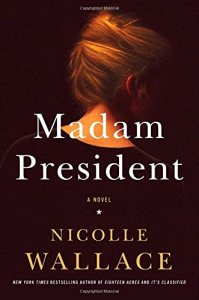
MADAME PRESIDENT by Nicolle Wallace

July 26, 2015
Click to purchase

Click to purchase

Narrated by Tavia Gilbert


I read Nicolle’s first two books in this series years ago, and enjoyed them. So when I heard about this new one, I tried the audiobook. The reader was good, but didn’t really add much to the story.

The premise is that there is a female Republican president in her second term, with a newish vice president, another woman who is a Democrat. Did I mention this is fiction? It goes from the ridiculous to fairytale; one of the White House staff had a two year affair with the President’s husband. They broke up, the President knew about it and promoted the mistress to Press Secretary. Spoiler alert: The White House Chief of Staff, probably the second most powerful person in Washington after the President (yes, I watched The West Wing) is leaking information to the press. Does he get fired? Of course not. He is just trusted not to do it anymore. Call me a cynic but I just couldn’t get past any of this stuff. Especially the press secretary. Would Hilary make Monica Lewinsky her press secretary? Not on a bet. ‘Nuff said.

The story is centered around a 9/11 style attack on five cities concurrently.  Lots of deaths, lots of sadness, but that’s just the beginning and ending of the book. The middle was just ridiculous.

I like Nicolle on The View. I think she is a smart Republican, and that is not something that often comes out of my mouth. I don’t agree with her politics, or many of her opinions, but I respect her. I am at the point in my life where if I don’t like a book for any reason, I generally put it down and move on. But I kept on going, hoping it would get better, hoping for some kind of reasonable explanation for the unexplainable, but never got it. I stayed with it until the bitter end, and I’m sorry I did.

7/15 Stacy Alesi, AKA the BookBitch

MADAME PRESIDENT by Nicolle Wallace. Atria/Emily Bestler Books (April 28, 2015).  ISBN 978-1476756899. 352 p.

Audio Book: Listening Length: 9 hours and 18 minutes

Kindle


IN THE UNLIKELY EVENT by Judy Blume

July 23, 2015
Click to purchase

Click to purchase

Narrated by Kathleen McInerney

I had seen the Judy Blume interviews on TV and knew that this was a book set in the early 1950s, when Blume was a teenager in Elizabeth, New Jersey, when three airplanes crashed in her town within 58 days. But I wasn’t thinking about that on my five hour flight from Fort Lauderdale to San Francisco, until the first plane crash (in the book!) As my oh-so-smooth Virgin America flight (thanks, guys!) was an hour or so in, I decided maybe listening to this book wasn’t the best idea I ever had. I set it aside and didn’t finish it until I got home.

Right up front I have to say that I didn’t love this narrator, mostly because of her pronunciation, from the main character, Miri Ammerman, who I heard as “Mary” and couldn’t understand at all – I’ve never met a Jew named Mary – to the synagogue, B’Nai something or other, which after hearing B’Nai pronounced as “Buh Nye” when it has always been “Buh Nay” in New York and Florida, and a few other mispronunciation of Jewish phrases all just sort of confused me and frankly, pissed me off. Someone is supposed to check these things.

But the story, the story! It’s wonderful, and not only because it’s Judy Blume and I don’t think she can write a bad book. The beginning sort of sets the tone and time period; women were mostly housewives, kids were respectful and kept in the dark a lot. We meet our main character, Miri, a 15 year old in Elizabeth, NJ who lives with her single mom, Rusty, with her grandmother and her uncle right next door. Mary’s uncle Henry is a newspaper man, and covers the plane crashes in great detail. Her best friend is Natalie, and Miri guiltily fantasizes about her mother marrying Natalie’s father (with nothing too terrible happening to Natalie’s mom) and having that comfortable, upper middle class life. And then the plane crashes start happening.

The plot is out there, you don’t need me to rehash it. Instead, let me tell you about the wonderful characters that Blume creates here,  unforgettable people who experience incredible tragedy. The survivors and how they dealt with it all. The brothers who lost their mother and their father is an alcoholic, so they live in a fairly nice orphanage – no foster care tragedy here. The families, some torn apart, with real problems and real solutions. The setting of this New Jersey town and how the people there come together because of these plane crashes is completely relatable to all the tragedies that have been in the news lately. The time period is portrayed in an almost romanticized way, yet it always rings true, from 1950’s Elizabeth, then later on, the new city in the desert, Las Vegas.

I am sorry I didn’t read the print (or Kindle) version and probably will on my next vacation. In the Unlikely Event was a completely fascinating and emotional read and listening to it (albeit briefly) on a plane gave me sharp recognition of where the title came from, even with the Virgin America music video version of the pre-flight safety instructions: “In the unlikely event/ We need to get you outside/ Your exit is equipped/ With an inflatable slide.”

If you like a good character driven story, good writing, and an interesting premise, then you will love this book as much as I did. Just read it, don’t listen to it.


7/15 Stacy Alesi, AKA the BookBitch

IN THE UNLIKELY EVENT by Judy Blume (Audio book.)  Random House Audio; Unabridged edition (June 2, 2015).  ISBN 978-1101914045. 11 discs.

Hardcover 

Kindle


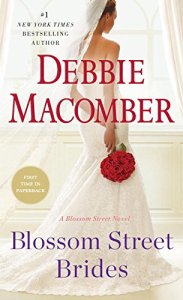
BLOSSOM STREET BRIDES by Debbie Macomber

July 12, 2015
Click to purchase

Click to purchase

Blossom Street #10

This is the latest entry into this very gentle series. It encompasses everything Debbie Macomber readers expect; women’s friendship, a sweet romance and knitting. The series is set in Seattle and centers around A Good Yarn, a knitting shop.

This time the story centers around Lauren Elliott, who works in a nearby fine jewelry establishment. Lauren and Todd, the handsome and ambitious TV newscaster, have been dating for a few years and Lauren feels like they should be ready to move on to the next step – marriage. But Todd wants to wait until he gets that coveted anchor spot, so Lauren decides to break it off.

Bethanne and her husband Max are separated – not because they don’t get along, but because they are newly married and he owns a business in partnership with Rooster in California; Bethanne’s business is in Seattle. And her ex has decided that maybe he made a mistake and wants her back.

Lauren meets Rooster at A Good Yarn, he’s a biker and totally out of her comfort zone but she decides maybe she needs to make a new list of what she wants in a man.

There is additional intrigue when baskets of yarn are found around town with notes to knit a scarf that will be donated to the homeless shelter, and the knitters are asked to turn in the finished product to A Good Yarn. But the proprietor, Lydia, doesn’t know anything about it, although she is certainly enjoying the good will and increase in business.

These women form a bond with each other and with the men in their lives, leading to a satisfying ending. I listened to the audiobook version of this book and it was completely captivating and entertaining. Narrated by Cassandra Campbell.

7/15 Stacy Alesi

BLOSSOM STREET BRIDES by Debbie Macomber. Ballantine Books (March 31, 2015). ISBN 978-0345528865. 432p.

Kindle

Audible


EIGHT HUNDRED GRAPES by Laura Dave

June 17, 2015
Click to purchase

Click to purchase

I like wine. A lot. But I didn’t know that it takes 800 grapes to make one bottle, and that was only one of the tidbits I picked up reading this fast paced, heartwarming novel.

At its heart this is a story about a family, but it happens that this family owns a small, biodynamic vineyard in Sonoma – and were one of the first families to settle there to make wine. The story is told from the viewpoint of the daughter, Georgia, a successful lawyer in southern California, and begins at her last wedding gown fitting.  As she looks out the window, she sees her fiancé strolling down the street with a drop dead gorgeous movie star and a little girl. She runs out after them, finds out that the little girl is his daughter and then Georgia makes a beeline for home – the vineyard.

Georgia’s parents are having problems, but they haven’t told her anything. She walks in and finds a towel clad man coming out of her parent’s bedroom – and the man is not her father. Then she finds out that her father is selling the vineyard to a “factory” wine maker – a large, successful commercial winery, and that the closing is right after her vineyard wedding, and she is incensed.

This is a family that is loaded with secrets, but their love for one another helps keep them afloat. The story moves around various timelines as it follows all the family members, but the chapters are short and the story is easy to follow. Besides all the family drama, there is romantic drama of the best kind as well.

I loved the setting, which becomes almost another character in this warm, wonderful novel. If you like wine and romance (and really, who doesn’t?) then this is the book for you.

6/15 Stacy Alesi, AKA the BookBitch

EIGHT HUNDRED GRAPES by Laura Dave. Simon & Schuster (June 2, 2015). ISBN 978-1476789255. 272p.


BEACH TOWN by Mary Kay Andrews

May 28, 2015
Click to purchase

Click to purchase

Once again I am kicking off my summer reading with Mary Kay Andrews and she is setting the bar high!

Greer Hennessy is a movie location scout looking for an old time Florida beach, which is getting real hard to find. But when she stumbles into Cypress Key in the Florida Panhandle, she knows she’s earned her paycheck. It’s lovely, with a pristine beach, one motel, and an old boarded up casino that is the perfect spot for the producer’s dream explosion.

But Greer runs into a problem her first night there, and his name is Eben Thibadeaux. He is the town mayor, engineer, hotel towel boy and more – and he is not about to let some Hollywood movie people destroy his town. Cypress Key already had a run of bad luck when the local paper mill polluted the area then left town, laying off everyone. The town is struggling and Eben is determined to bring it back from the brink without blowing anything up, especially an historic landmark like the casino.

But Greer is determined and sweet talks her way into almost everything she needs, with bribes taking care of what the sweet talk won’t. But blowing up the casino is becoming a real issue on both sides when the movie bigwigs find out how far over the budget has gone.

Greer and Eben are meeting and fighting regularly, but also fighting a strong attraction to each other and they lose that fight for sure. Andrews excels at creating characters that are full realized and believable, and their story just draws you in, making this a true page turner.

The romance builds and things get really hot in this sweet, sexy beach read that is the perfect way to kick off summer. I loved it!

5/15 Stacy Alesi AKA the BookBitch

BEACH TOWN by Mary Kay Andrews. St. Martin’s Press (May 19, 2015). ISBN: 978-1250065933. 448p.


LOVE AND MISS COMMUNICATION by Elyssa Friedland

May 22, 2015

love & miss communicationEvie Rosen is addicted to the Internet. Her phone is always by her side and even in the most intimate of settings – well, the most intimate of settings Evie’s seeing these days, i.e. friends’ weddings and a few blind dates that go nowhere – she never misses a tweet or status update. It’s possible that her need to stay connected is affecting her friendships and relationships, or lack thereof… like the time she was called out for Googling one of those blind dates.

But then Evie is fired for spending too much of her work time on personal emails. Reeling over her new unemployment situation, Evie binges on a Facebook stalking session and discovers that her allergic-to-marriage ex has just tied the knot. The results of that revelation are embarrassing, to say the least, and prompt Evie to finally admit that she has a real problem. And so she decides to give it all up. But going Internet free isn’t necessarily easy, especially in a day and age when everyone is expected to take part in the social media circus. And for a girl who’s single and unemployed, it means getting a little creative about dating and job hunting.

Elyssa Friedland’s debut is a fun and eye-opening look at today’s always connected, always updating online frenzy. But it’s more than just a girl experiencing the inconveniences of internet-free living. Love and Miss Communication is a story about the importance of family, friends, and real connections rather than friend requests.

05/15 Becky LeJeune

LOVE AND MISS COMMUNICATION by Elyssa Friedland. William Morrow Paperbacks (May 12, 2015). ISBN: 978-0062379849. 400p.


Guest Blogger: Jacob Rubin

March 17, 2015
Click to purchase

Click to purchase

Win a copy of Jacob Rubin’s caffeinated and wildly comic debut novel, which was recently selected a Barnes & Noble Discover Great New Writers pick for spring 2015 and named a one of Huffington Post’s 2015 Books We Can’t Wait to Read.

In the same vein as George Saunders and Sam Lipsyte, THE POSER chronicles the hijinks and crises of Giovanni Bernini, the World’s Greatest Impressionist—a man whose bizarre compulsion and ability to imitate anyone he meets catapults him from small-town obscurity to widespread fame. As he describes it, “No one disguise is perfect. There is in every person, no matter how graceful, a seam, a thread curling out of them. . . .  When pulled by the right hands, it will unravel the person entire.”

Honed by his theatrical mother at a young age, his talent eventually takes him from his hometown to the nightclubs of the City and eventually the sound stages of Fantasma Falls, the glamorous, west coast city similar to Hollywood. As Giovanni’s fame grows, he encounters a cast of provocative characters—including an exuberant manager, a mysterious chanteuse, an enigmatic psychoanalyst, and a deaf obsessive compulsive—and becomes increasingly trapped inside many personas. When his bizarre talent comes to define him, Giovanni is forced to assume the one identity he has never been able to master: his own.

At its heart, the novel speaks to the power of performance, impersonation, acting, and what it means to find and understand the essence of someone, and of yourself. I think author Sam Lipsyte nails it when he says Rubin “is a great hope for comic fiction in the 21st century.” Though THE POSER is his debut, it certainly announces the arrival of a new and unmistakable voice in American fiction.

Check out the Book Trailer

Q&A with Jacob Rubin, author of THE POSER

Giovanni Bernini, The Poser’s protagonist, is known as the World’s Greatest Impressionist. He’s born with the uncanny ability to imitate anyone he meets instantaneously. Throughout the literary spectrum, plenty of stories have been written about performers or performing, but not impressionists specifically. How did you conjure up such an interesting character?

The Poser began, oddly enough, in the trash. Years ago I was working on a not very good short story about a man who wakes up in a woman’s apartment after a one-night stand. Remembering little of the night before, he begins to root around in her garbage for clues. One of the items he finds was, to my surprise, a black-and-white photo of a famed impressionist, a man who could famously imitate anyone he met. As I soon discovered, I was much more interested in this unexpected performer than I was in the guy who discovered him. I scrapped the story right then and wrote another one, very quickly, about this character Giovanni Bernini. After many years, it became The Poser.

You have experience as a performer—both as a juggler for hire and as the lead rapper of the hip-hop group Witness Protection Program, opening for groups like Jurassic Five and Blackalicious, to name a few. How has your background as a performer influenced the creation of Giovanni Bernini?

I can’t seem to get away from performance, in life or in writing. Personae, masks, fraudulence, disguise—all have fascinated me for as long as I can remember. I think a lot about that Picasso line: that art is a “lie that tells the truth.” It seems to me this paradox can obtain in life, too. Like, I once read an article in the Times about a survivor of 9/11, a woman who had been in the south tower when the planes hit. After the tragedy, she organized these legendary support groups. They were these deeply cathartic events, arranged with great thought and care. Survivors and relatives of victims depended on her entirely, so strong was her empathy. Only later did it come out that this woman hadn’t been in the towers at all—she made the whole thing up. I find such behavior deeply disturbing, of course, but fascinating, too. The lie, for this woman at least, clearly felt like an emotional truth.

I did stand-up comedy for a little while, and I think the status of the stand-up comedian reflects a similar paradox: instead of a lie that tells the truth, maybe a stand-up states a truth so serious it has to be packaged as a joke. The stage offers a kind of loophole, a free zone in which what would otherwise be punishably inappropriate can be aired with impunity, even to applause. It’s what performance offers in general, I think: this magical, cordoned-off space where people can lie, hurl abuse, decompensate, and the crowd hoorahs! In The Poser, I wanted to explore a character who finds that his previously outrageous behavior is celebrated simply because it’s put on the stage.

A man with a million personas, Giovanni seemingly can be anyone except himself and at one point in the story undergoes psychoanalysis. Coming from a family of psychiatrists yourself, you must have some insight into analysis and some rather interesting stories, to boot. Will you talk briefly about growing up among psychoanalysts and how that may have shaped Giovanni as a character and the story as a whole?

My grandfather, Theodore Isaac Rubin, was a very famous psychiatrist in the 60s, 70s, and 80s. He appeared regularly on the Phil Donoghue show and wrote many bestselling novels and self-help books, one of which was turned into an Oscar-nominated movie, David and Lisa. Largely because of his influence, my father, aunt, and uncle all went on to become shrinks. Suffice it to say, there is no dearth of introspection at our family get-togethers. (Somewhat notoriously, I informed a classmate of mine in the third grade that he was “projecting”; I am still living this down.) And yet I also wanted to show how beneficial therapy can be. I think portrayals of analysis in books and movies are often pretty lazy, framing it as this ridiculous or masturbatory exercise. I wanted to show that there is true empathy in it – a kind of warm detachment – that can really help people.

The Poser is told from Giovanni’s perspective, at a point in his life where he’s looking back at everything that’s befallen him. What compelled you to use first-person confession as the mode for telling the story?

The enjoinder to “show don’t tell” is important for every young writer to hear, and yet so many of my favorite books wholly disregard it. Notes from the Underground, for instance, or Walker Percy’s The Moviegoer, the novels of Robertson Davies and Stanley Elkin. Everyone knows novels can’t compete with movies or video games for sheer sensory onslaught, but books, for my money, capture better than any other media the interiority of experience, the “music of someone’s intelligence,” as Richard Ford once put it. My favorite books promise just this kind of intimate—and for that reason, often scandalous—experience. Like, Lolita or Denis Johnson’s Jesus’s Son. You open those books, and you’re encountering this presence, this personality talking about something it shouldn’t have done in a voice unlike any you’ve ever heard. My favorite books, probably for that reason, feel like a secret, and you feel slightly cheated when you find out someone else read it. You’re like, “Hands off. She told that to me and no one else.”

Thematically, I thought the first-person narrative was necessary for The Poser as it’s about a man struggling to find himself, which he does, in the end, by telling the story. I also liked the tension of having someone act a certain way, as a performer or fraud, while narrating his often discordant internal experience. He says one thing, but thinks another. This is something I think fiction can do particularly well.

Giovanni’s world is noir-ish, vaudevillian, even a bit surreal. The story is set in an imaginary country that somewhat resembles America of the 1950s and 60s. What was your thought process in setting the story in a parallel, fable-like world?  Did you do any research to flesh out its wonderful detail?

I knew I was taking a risk in setting the book in an imaginary place, a parallel America of the 50s and 60s, and yet it felt necessary for the kind of book I was hoping to write. The Poser, as I see it, is about Giovanni’s attempt to become a real person; it felt right that the landscape, too, might strain to be real, flickering between the evoked and the shadowy. I did do research about the corresponding time in America. Stuff about clothes, some slang, etc. I used as models for the noir prose style novels by favorites like Jim Thompson and Raymond Chandler.

I can’t seem to escape the surreal. In visual art, it’s always been my favorite: Giacometti’s sculptures, for instance, or the paintings of Paul Klee. I think I’ve always aspired to whatever the prose equivalent of such a way of seeing would be. For me, it is rare that when meeting a person I note what color nail polish she’s wearing or which kind of ankle boot (this can be very embarrassing, mind you, for someone meant to be observant). Encountering a person can be a pretty damn surreal experience, much more like meeting a Giacometti or a Klee. I think the same is true of places. Just walking around and seeing people yammering on their cellphones or driving around in these motorized chrome bubbles—we live in a sci-fi movie! My agent, Jin Auh, once relayed a line the author George Garrett had about Fellini’s movies. He called them “science fiction set in the past.” I loved that. I think that’s what I’m trying to write.

Bestselling author Sam Lipsyte praised you as “a great hope for comic fiction in the 21st century.” Did you set out to write a humorous book? Were there any books or authors—comedic or otherwise—who inspired you while writing The Poser?

Sam Lipsyte has made me laugh so many times, so I was on cloud nine when I found out he enjoyed the book. I certainly hope the novel’s funny. My old teacher Barry Hannah used to say that books should offer “deep entertainment”; the unkillable ham in me can’t seem to let go of the second word. All of my favorite contemporary writers make me laugh: Jennifer Egan, Jonathan Lethem, Sam Lipsyte, Barry. Even very dark, supposedly depressing, classics are secretly knee-slappers. I’m thinking of writers like Knut Hamsun, Thomas Bernhard, Samuel Beckett, and Herman Melville. I read Paul Auster’s introduction to Hunger, in which Auster talks about how dark and miserable the book is (all of which is true, of course), but I also thought, it’s hilarious! The truly tragic is the funniest stuff there is! The fact that we live on a spinning ball in an endless void, or that we possess a seemingly infinite consciousness but will all die. It’s just so absurd. I think laugher is the sound of someone accepting their powerlessness and through that acceptance briefly somehow transcending it. And it shouldn’t ever be explained. And I now ruined it forever.

Besides working as a novelist, a magician, and a rapper, you also write screenplays. In fact, Times Square, a script you co-wrote with Taylor Materne, was recently optioned by Focus Features. In your opinion, what’s the biggest difference between writing a novel and a script, and do you prefer writing one form over the other?

I’ve found the two to be very different. In film, structure is king, so you really have to work out the entire plot as much as you can before setting off to write. It helps a lot to work with someone else to figure out what needs to happen when.  Of course, you often end up changing nearly everything anyway, but it’s almost more like assembling a watch or engine, some device that has to meet company-mandated specs. Fiction writing, for me, is a much more unwieldy, inefficient, foolhardy, and reliably meaningful experience. That said, I’ve always enjoyed writing dialogue, and the script stuff is a fun opportunity to pen snappy exchanges. In movie writing, you get to put down things like, “NO WAY OUT. The green creature on his heels, he GRABS the duffel bag and – screw it – LEAPS OFF the roof over the sea wall to the CHURNING WATERS of the GULF of MEXICO.”

The Poser is your debut novel. Is there a second in the works? If so, could you talk a bit about it? If not, would you mind divulging what other creative projects you’re currently working on?

There is a lengthy word file in my laptop that I hesitate to call a second novel, but perhaps it will be one day! It is too early to talk about it, but I hope it will be funny.

To win your own copy, please send an email to contest@gmail.com with “WIN POSER” as the subject.

You must include your snail mail address in your email.

All entries must be received by March 31, 2015. Two (2) names will be drawn from all qualified entries and notified via email. This contest is open to all adults over 18 years of age in the United States only. Your book will be sent by the publisher, Viking Press.

One entry per email address. Subscribers to the monthly newsletter earn an extra entry into every contest. Follow this blog to earn another entry into every contest. Winners may win only one time per year (365 days) for contests with prizes of more than one book. Your email address will not be shared or sold to anyone.

3/15 Stacy Alesi, AKA the BookBitch

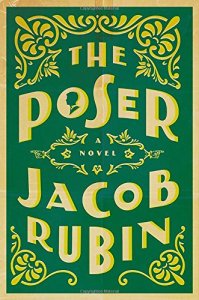
THE POSER by Jacob Rubin. Viking (March 17, 2015). ISBN 978-0670016761. 256p.

Win THE NIGHTINGALE by Kristin Hannah

February 3, 2015

Click to purchase

I loved this book so much that I want one lucky reader to get a free copy! Read on for my review and how you can enter to win.

This was quite a departure for Hannah, who typically writes really good stories about contemporary women’s lives. This time she starts out that way, but quickly goes back in time to 1939 France as the war is getting underway.

Sisters Isabelle and Viann have lost their mother, and their father, damaged from World War I, can’t deal with his loss and his daughters so he sends them away. Isabelle is rebellious and gets kicked out of one boarding school after another, until she’s sent to live with her older sister Viann and her husband. Things don’t work out there and the sisters part ways. But when Viann’s husband goes off to war, eighteen year old Isabelle is sent back to stay with her sister again.

Isabelle wants to be involved in the war effort, but not in a typical-of-the-time way of rolling bandages. When she meets Gäetan, a partisan rebel, she falls in love and wants to go off with him to fight, but he sneaks away, leaving her angry, frustrated and heartbroken. As the Nazis move in to France, the country is divided in two, the Nazi occupied territory, and the Free Zone under Vichy government. The sisters’ small town is taken over by Nazis, and one is billeted in their home.

Isabelle joins the Resistance movement at great personal risk. Her exploits become legendary as eventually she leads downed British and American airmen out of France, walking them across the mountains into Spain and freedom. She becomes known as the Nightingale.

Meanwhile, back at home, Viann’s best friend Rachel is Jewish, and we all know what happens there. She begs Viann to take her baby boy, and as dangerous as it is, Viann acquiesces. Then another Jewish friend is being taken away, and leaves her son as well. Viann knows she can’t keep another Jewish child, so she approaches the Mother Superior at the local convent orphanage, and they take the child. They decide there will be more Jewish children to be saved, and eventually Viann saves several more.

The story moves occasionally back to contemporary times, when one of the sisters is being moved to a nursing home by her son, a doctor, who knows nothing of his mother and her sister’s past – and, in a brilliant stroke on Hannah’s part, we don’t know which sister she is.

This was a completely mesmerizing story, a female side of the war that isn’t often explored. I was totally immersed in their world, and often brought to tears. It is a difficult subject, and the brutality and violence is not whitewashed at all, but is necessary to the story. I have read a lot of Holocaust fiction and this was one of the more interesting, unusual and compelling books on the subject. This strong, well written feminist historical fiction is simply not to be missed. It is sure to make my favorite list for 2015.

To win your own copy, please send an email to contest@gmail.com with “WIN NIGHTINGALE” as the subject.

You must include your snail mail address in your email.

All entries must be received by February 20, 2015. One (1) name will be drawn from all qualified entries and notified via email. This contest is open to all adults over 18 years of age in the United States only. Your book will be sent by the publisher, St. Martins Press.

One entry per email address. Subscribers to the monthly newsletter earn an extra entry into every contest. Follow this blog to earn another entry into every contest. Winners may win only one time per year (365 days) for contests with prizes of more than one book. Your email address will not be shared or sold to anyone.

1/15 Stacy Alesi, AKA the BookBitch

THE NIGHTINGALE by Kristin Hannah. St. Martin’s Press (February 3, 2015). ISBN 978-0312577223. 448p.


SAVING GRACE by Jane Green

January 24, 2015

Click to purchase

I’ve been reading Jane Green since Jemima J., and have really loved how her books have evolved over the years. Saving Grace is another step forward for this terrific author.

Grace and Ted Chapman have been married for twenty years, living an idyllic life in New York’s Hudson Valley. He is a hugely successful literary author, and she is part of his support system; his beautiful, gracious wife, hostess of lavish dinner parties, and board member of a local charity where she teaches women to cook.

But unbeknownst to outsiders looking in at this power couple, Ted has some anger issues, and Grace lives her life walking on eggshells. Ted has an assistant who really keeps it all together, so when she needs to retire, they need a replacement and fast.

Enter Beth, the perfect assistant. She moves in and takes over and Ted is happy; Grace is uneasy but can’t quite put her finger on the problem. Then odd things start to happen, and Grace finds her life spiraling out of control. Beth is playing devious, diabolical games with this family and as the story unfurls, one shocking disaster after another, there doesn’t seem to be a way out for any of them.

Until Grace takes off for home – England. There she slowly recovers from all the damage and learns how to put her life back together. But even with that success, there are still more shocking revelations ahead.

This book was completely unputdownable. The characters are well developed, real, and memorable. The suspense builds throughout, never letting up, until the dramatic ending. Green focuses on problems of mental illness and the prescription drug epidemic in this country, in a way that inspires thoughtful discussion. A great read for book groups for sure.

1/15 Stacy Alesi, AKA the BookBitch

SAVING GRACE by Jane Green. St. Martin’s Press (December 30, 2014). ISBN 978-1250047335. 320p.


THE BOSTON GIRL by Anita Diamant

January 15, 2015

Click to purchase

Anita Diamant, author of the much beloved The Red Tent (and several other books) hasn’t had a new book in a few years so this was highly anticipated. I am happy to say it was worth the wait.

Touching on her usual themes of Judaism, feminism and history, The Boston Girl is also heartwarming and engaging – I couldn’t put it down.

Diamant utilizes a common plot device; the heroine, Addie Baum, is 85 years old and telling her life story to her granddaughter (with much more detail than my grandmother ever remembered.) This is a poignant family story about the immigrant experience in Boston, Massachusetts. The characters are well drawn, especially Addie and her immediate family, but the secondary characters are more shadowy. Since the story is told in the first person, we can only know what Addie knows.

Addie lived through a severe flu epidemic, the Great Depression, women’s rights and lots more, all brought to life through the lens of the Baum family. I won’t be forgetting this family any time soon.

1/15 Stacy Alesi, AKA the BookBitch

THE BOSTON GIRL by Anita Diamant. Scribner (December 9, 2014). ISBN 978-1439199350. 336p.