
Click to purchase
I am delighted to welcome Linnea Hartsuyker to the blog!
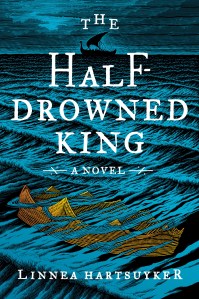
Behind The Half-Drowned King
by Linnea Hartsuyker
In D’Aulaires’ Trolls, a nine-headed troll in the Norwegian Mountains steals nine princesses from their father so each of the women can massage one of his itchy, lice-ridden heads, all of which are constantly arguing with one another and keeping the others from sleep. My father, a wonderful storyteller, scowled and scratched his own head when he got to this part, demonstrating why the troll needed these maidens. Eventually, a hero strong enough to lift the troll’s giant sword came along, killed the troll with one blow, rescued the nine princesses, and married the eldest.
Tales of Norse gods and giants formed the imaginative bedrock of my childhood. These were the legends of my ancestors and, growing up in the middle of the woods in upstate New York, it wasn’t hard to picture myself in the deep, dark Norwegian woods where giants lived in caves and battled with heroes. Scandinavian legends explained why my family was so much taller than my friends’, why I loved the cold and the snow, why my mother made pepperkaker cookies at Christmas and decorated the house with straw goats and wooden Dala horses.
The women in these stories were remarkable as well: the giantess Gefjon who turned her sons into oxen and plowed so deeply that she separated Zeeland from the Danish mainland, or Skadi who forced the Aesir gods to give her a husband, but had to choose him by looking only at his legs. There was not much difference between gods, trolls, and giants in this world; a brutal giant father could have a beautiful giant daughter desired by the handsomest gods. In the Norse heaven, warriors battled each other all day and then put their limbs and bodies back together to drink and feast all night.
Living in the country, I learned about the work it would take an ancient Norse family to stay alive through a cold winter. My family skied our frozen forest, and heated our house with stoves that required constant chopping and carrying of firewood. I learned to knit, weave, and sew at a young age, because those were my mother’s hobbies, and she saw virtue in knowing how to do things from scratch, from baking bread to making clothing.
When I was in my teens, one of my relatives decided to trace the Scandinavian side of our family, identified all of our relatives back to Alma, five generations ago in Sweden, and we met many new cousins through our explorations. What intrigued me more than the recent history, though, was the misty recesses of the family tree; Scandinavia’s church records are nearly unbroken back to the coming of Christianity in the 11th century, and beyond that, the sagas record ancestry back to the loins of gods and giants. One branch of my family can be traced to Harald Fairhair, the first king of Norway in the 9th century.
Because Harald fathered over twenty sons, most people with any northern European ancestors can trace their lineage back to him. But learning that did not put a damper on my imagination. As an undergraduate, I researched Harald in Cornell’s libraries, reading The Heimskringla, the Saga of Norwegian Kings written by Snorri Sturlusson, when I was supposed to be doing my engineering homework, and learned about the princess Gyda who said that she would only marry Harald if he conquered all of Norway, so he swore he would not cut his hair or shave his beard until he had done so, and fifteen years later, he came back and married her.
When I began trying to write novels and short stories more seriously in my early twenties, I always thought that someday I would write the story of Harald and Gyda—once I had practiced enough, and had enough confidence as a writer. But one night, after bogging down while attempting to write another novel I didn’t care enough about, I decided that if I only wrote one story in my life, it should be this, and I was wasting time working on anything else. In Harald’s story, I found a world in which I could spend years, because, in many ways, I already had.
In reading The Heimskringla again, this time as a writer, I found that Harald’s story is not a particularly compelling narrative for a novelist: Harald is the brightest and the best and he always wins. In Arthurian retellings that King Arthur is often the least interesting character; it’s the people he surrounds himself with, torn between duty and their own desires, who have far more engaging stories. At Harald’s side, I found Ragnvald of Maer, his right-hand man, who makes hard sacrifices for his attachment to Harald. The Heimskringla gives only a bare-bones account of Ragnvald’s involvement Harald’s conquest, leaving plenty of room for invention. And Ragnvald had a sister Svanhild about whom even less was known; together they provide a canvas for a tale of betrayal and hard choices, of families torn apart, and brought back together again.
The dawn of the Scandinavian kingdoms was a fascinating time. Small kingdoms sent out viking raiding parties against one another and all of Northern Europe, terrorizing monasteries, and sacking Paris—twice. Early Norse kings ruled only as far as they could walk or sail in a day. Women had a great deal of agency and independence: they could divorce their husbands, and, as widows, own property and even command armies. But they could not swear oaths or testify at trials unless a man could not be found to stand witness, and were not required to consent to marriages. Without reliable birth control, they were bound to constant childbearing, which often killed them young.
I wondered what about 9th century Norway would make some people long for the security of a king, and others rebel and strike out to found the shockingly democratic country of medieval Iceland. In The Half-Drowned King, Ragnvald and his sister Svanhild embody two sides of that conflict, and much like in fantasy or science fiction, I hope that showing how people navigate these issues in a very different world illuminates something about how we confront them now.
An Indie Next Pick for August 2017
A Barnes & Noble Discover New Writers Pick for Summer 2017
ABOUT THE BOOK
THE HALF-DROWNED KING (Harper; $27.99/$34.99 Can.; Hardcover; ISBN: 9780062563699; on sale August 1, 2017), Linnea Hartsuyker’s assured and compelling debut novel, launches an epic saga drawn from her own Scandinavian lineage. This first installment in a trilogy brings to life the cold and violent ninth century when Norway’s first king, Harald the Fair-Haired, united a warring nation and ascended to the throne. Drawing on extensive research, Hartsuyker crafts a richly-veined work of historical fiction that is propelled by her natural storytelling gifts. “Steeped in legend and myth, Hartsuyker’s debut is a swashbuckling epic of family, love, and betrayal that reimagines the Norse sagas,” says Kirkus Reviews, “While Hartsuyker’s prose is straightforward, the plot is as deliciously complex as Game of Thrones. And, in an era so dominated by the tales of men, it’s nice to see a complicated, cunning heroine like Svanhild swoop in and steal the show. Hold on to your helms and grab your shields—Hartsuyker is just getting started.”
While THE HALF-DROWNED KING is a work of fiction, it takes its inspiration from classic Norwegian texts. “In the thirteenth century the Icelander Snorri Sturluson, a historian, poet, and politician, would write down theHeimskringla, and many other sagas—roughly the equivalent of someone today writing the story of the founding of the United States with only oral tradition on which to base his narrative,” reports Hartsuyker, who has traced her own direct bloodline back 1200 years to Harald the Fair-Haired. “The Heimskringla almost certainly has gaps and inaccuracies…. In writing The Half-Drowned King, I have used the stories in the Heimskringla as a jumping-off point, and also asked myself what might have been the real events behind the stories that Snorri Sturluson and others passed on and recorded.”
The story Hartsuyker crafts from this historical raw material is exhilarating. In an age of chaos, a hundred petty rulers are willing to kill over the smallest parcels of land. But, a prophecy has promised the rise of a high king who will unite all of Norway. While sailing home from a raiding trip to Ireland, Ragnvald Eysteinsson—the son and grandson of kings—is attacked and left for dead by a man he thought an ally. The attempted killing, he will learn was engineered by his own stepfather, Olaf, who wishes to claim Ragnvald’s land and birthright as his own. Rescued by a fisherman and nursed to health by a widow trying to survive on the land of her slaughtered husband, Ragnvald plots his return and his vengeance.
After the death of their father in battle, Ragnvald has sworn to protect his sister, Svanhild, who, as a woman, has remained behind with their mother and the scheming Olaf. Because of her sex, Svanhild is simply expected to make an advantageous marriage and leave matters of honor to men. Without Ragnvald to protect her, Svanhild could easily be married off to the man of her stepfather’s choosing. But her independent mind and adventurous spirit drive her to take control of her fate. When the chance to leave her stepfather’s cruelty comes at the hand of her brother’s arch rival, Svanhild is forced to make the ultimate choice: family or freedom. Meanwhile, Ragnvald sees opportunity with Harald of Vestfold, the strong young Norse warrior rumored to be the prophesied king. Ragnvald pledges his sword to Harald, a choice that will hold enormous consequence in the years to come.
Critics are raving!
“Making her fiction debut, Hartsuyker, who claims descent from Norway’s first king, writes an absolutely top-notch Viking saga, and readers will eagerly await the next two volumes in this trilogy.”
— Library Journal, *Starred Review*
“A terrific historical epic…Posing thoughtful questions about the nature of honor and heroism, and devoting significant attention to women’s lives, the novel takes a fresh approach to the Viking adventure genre…The action scenes will have the blood humming in your veins.”
—Booklist, *Starred Review*
“Steeped in legend and myth, Hartsuyker’s debut is a swashbuckling epic of family, love, and betrayal that reimagines the Norse sagas….While Hartsuyker’s prose is straightforward, the plot is as deliciously complex as Game of Thrones. And, in an era so dominated by the tales of men, it’s nice to see a complicated, cunning heroine like Svanhild swoop in and steal the show. Hold on to your helms and grab your shields—Hartsuyker is just getting started.”
— Kirkus Reviews
“The author, who can trace her lineage back to Harald Halfdansson, recreates the half-civilized, half-primitive landscape of his time, where a dragon boat sailing up a fjord struck dread in all who saw it. Befitting its subject matter, the book is replete with exciting battles, duels, and sieges, but the author makes Svanhild’s domestic tribulations equally dramatic. In the end, this novel can stand proudly with Edison Marshall’s The Viking and Frans G. Bengtsson’s The Long Ships as an immersive fictional recreation of a bloody moment in Scandinavian history.”
—Publishers Weekly
“A spellbinding evocation of a long-lost world of magic and blood feuds, populated by characters riddled with doubt and human failing beneath their epic exteriors.” — BookPage
“Suspenseful, intriguing, gripping!… Treachery and astonishment and surprise are always right around the corner…As with all great historical fiction, there are strong similarities to actual events. Good research is very important to a believable historical novel. This book has it. If you enjoy Bernard Cornwell, do not pass this book by. It is well worth the read!”
— New York Journal of Books
“Inspired by the Icelandic sagas, this action-packed first volume in a planned trilogy will transport readers to Viking Norway, where Ragnvald battles his treacherous stepfather in order to claim his true birthright after his father’s death. Meanwhile, Ragnvald’s sister Svanhild seeks a marriage that will give her the freedom she craves despite the era’s restrictive social roles for women. An adventurous summer read, in which vivid historical detail meets a fast-moving plot.”
— Library Journal’s List of Summer Escapes
“Game of Thrones will be back on our screens by the time this epic Viking saga comes out, and it’s a safe literary bet for those of us who enjoy a bit of Westeros action. Ragnvald Eysteinsson is betrayed by his avaricious stepfather, and in trying to gain back his rightful inheritance, he pledges his sword to a young warrior plotting to become the king. If you like your heroes noble and your struggles for power bloody, this one’s for you.”
— 24 Best books To Read This Summer from Elle.com
“Linnea Hartsuyker brings myth and legend roaring to life in this superbly good page-turning saga of Viking-era Norway. Hartsuyker is fearless as she navigates a harsh, exacting and hair-raising world, with icy fjords and raiding seasons and ancient blood feuds. But the book’s fiercest magic shines in the characters of Ragnvald and Svanhild, as unforgettable a brother and sister duo as I can remember in recent literature. Linnea Hartsuyker is an exciting, original voice in historical fiction, and The Half-Drowned King is nothing short of mesmerizing.”
— Paula McLain, bestselling author of THE PARIS WIFE and CIRCLING THE SUN
 ABOUT THE AUTHOR
Linnea Hartsuyker grew up outside Ithaca, New York, and studied Engineering at Cornell University. She received an MFA in Creative Writing from NYU. She has read extensively of Icelandic sagas, kayaked and skied the fjordland settings for this novel, and has even become proficient in lifting Husafjell stones, as the Vikings did to become stronger. She lives in New York City with her husband. For more on Linnea and her writing, visit: http://www.linneahartsuyker.com/
A Conversation with Linnea Hartsuyker, author of THE HALF-DROWNED KING
Q.: Your debut novel, THE HALF-DROWNED KING, is set in ninth century Norway. What is your personal connection to the story?
When I was in my late teens, one of my relatives decided to trace our Scandinavian ancestry and identified all of our relatives back to Alma, five generations ago in Sweden. Scandinavian church records are nearly unbroken back to the coming of Christianity in the 11th century, and beyond that, the sagas record ancestry back to the loins of gods and giants. We found that one branch of the family descends from Harald Fairhair, the first king of Norway in the 9th century.
I was fascinated by this connection and when I went to college, I researched Harald in Cornell’s libraries, reading The Heimskringla, the Saga of Norwegian Kings written by Snorri Sturlusson, when I was supposed to be doing my engineering homework. I learned about Princess Gyda who proclaimed that she would only marry Harald if he conquered all of Norway, so he swore he would not cut his hair or shave his beard until he had done so, and fifteen years later, he returned and married her.
My mother is a geneticist, and when we found out about our ancestry, she calculated how much genetic material we would share with Harald—some fraction of a single chromosome—and in my later research, I learned that most people with Northern European ancestry are descended from Harald, but it did not dim my enthusiasm.
Q.: What inspired you to write a novel—the first in a trilogy in fact—that focuses on this long-ago period in history?
I grew up on a dirt road in the wilderness of upstate New York, where my family skied our frozen forest, and heated our house with stoves that required constant chopping and carrying of firewood. I learned to knit, weave, and sew at a young age, because those were my mother’s hobbies, and she saw a virtue in knowing how to do things from scratch, from baking bread to making clothing.
My parents both love legend and folk lore, and I grew up with books of women-centric folk tales like Tatterhood and Maid of the North, and also the tales of my Norse ancestors. I loved the Little House books by Laura Ingalls Wilder, and wanted to live in the 1850s, if not earlier.
When I got serious about writing as more than a hobby, in my late twenties, I was living in New York City, but a part of me always felt more connected to deep, dark woods and ancient legends than to the modern world. I no longer want to live then—I love modern conveniences—but I also love imagining what life was like in Viking-age Norway. A writing teacher once told me that you should write a novel about something you’re obsessed with; because you will spend so long with it, you will need that obsession to pull you through. I have always been obsessed with the borders between history and legend, between myth and reality. In telling the story of Harald, Ragnvald, and Svanhild, I am drawing on and expanding my own foundational myths.
Q.: Who are Ragnvald and Svanhild, and why did you decide to focus the story on them rather than Harald, who became the first king of Norway?
When I did decide to tackle this story, I re-read the Harald portions of The Heimskringla, and found that King Harald’s story is not a particularly compelling narrative for a novelist: Harald is the brightest and the best and he always wins. In Arthurian retellings that King Arthur is often the least interesting character; it’s the people he surrounds himself with, torn between duty and their own desires, who have far more engaging stories.
At Harald’s side, I found Ragnvald of Maer, his right-hand man, who makes hard sacrifices because of his attachment to Harald. The Heimskringla gives only a bare-bones account of Ragnvald’s involvement Harald’s conquest, leaving plenty of room for invention, but what we do know sketches a fascinating, conflicted character. And he had a sister about whom even less was known; together they provide a canvas for a tale of betrayal and hard choices, of families torn apart, and brought back together again.
Q.: How much about Ragnvald and Svanhild is based on fact and how much did you fabricate for dramatic purposes?
I have taken some liberties in order to tell the story I wanted. The primary sources only relate a few important events involving Ragnvald and his children. Nothing of Svanhild is known beyond her name and one of her husbands. I created other aspects of Ragnvald and Svanhild’s backgrounds and personalities to fit these scraps of information—adding a personal dimension to a political conflict. I noticed that Ragnvald names his son Ivar after his grandfather, but none of his sons or grandsons are named for his father Eystein, who was known as Eystein the Noisy—the implication being that he was a boaster. What kind of son would a boaster have? Perhaps a taciturn young man, uncomfortable with praise.
With Ragnvald, I wanted to explore why a highly capable man, older than the king he serves, would do
so much for him, and never rebel even when he had reason to? From there I imagined a young man descended from kings but whose family has fallen in recent generations, whose upbringing has caused him to doubt his abilities and curtail his ambitions, and who would eventually grow into the man known as Ragnvald the Mighty.
Q.: When did Christianity reach Norway? Your characters still pay homage to the gods Ran and Odin. Did Ragnvald and Solvi learn of this new religion from their travels?
The Half-Drowned King begins around 860 or 870 CE. At that point, even Germany and England had only officially been Christian for 150 years. The Vikings were aware of Christianity, but unlike the Frankish Empire and England, their rulers had no political reasons to become Christian. The Half-Drowned King is about the consolidation of power in Norway, at a time when all of the Scandinavian kingdoms transitioning from regional rule to nations with kings.
Vikings believed their gods gave them good harvests and victory in battle, and understood that different people had different gods; they believed in the Christian God and Christ as much as in their own gods, but thought that their gods must be stronger, as long as they won in battle. They would not be interested in throwing over their own gods for a weaker god.
Once they started to lose battles to Christians, Christianity became more attractive. At the same time, in the early 11th century, Scandinavian rulers began to see the value in converting to Christianity so they could make alliances with other Christian kings. The church also provided an educated, literate class of bureaucrats—priests and other church officials—who could help them administer their larger countries.
Q.: It is rare to have a woman as a central character in fiction set in this time period, and yet that is exactly what you have done with the character of Svanhild. Was this a conscious choice, spurred by twenty-first century awareness, or simply the result of her having been an important figure?
Svanhild is only mentioned briefly in The Heimskringla and no other sources, but as Ragnvald’s sister, and a player in the era’s politics, she could be as important as her brother. I wanted to create a character who was plausible for the Viking Age—not a 21st century feminist woman in period clothing—while making her sympathetic to modern readers. The Icelandic sagas are full of women who cause trouble, and spur their reluctant husbands on to vengeance or other actions. Wealthy women, especially widows, could also accrue a great deal of power. I wanted Svanhild to be aware of the influence she can wield, while also feeling trapped by the unique pressures of womanhood in her era.
Women’s stories have always been erased from recorded history, and in fiction, are often shunted into their own genre. In writing this book, I struggled with the fact that we know much more of men’s history and actions. I tried to give my women characters unique personalities and understandable motivations, rather than making them only helpers and maintainers of the men in their lives. I wanted The Half-Drowned King to show the various ways women could wield power: through their sexuality, childrearing and housekeeping, and even occasionally in politics and warfare.
Q.: What did you do to research the novel? Did you spend time in Norway? Do you speak Norwegian?
I researched The Half-Drowned King by reading a great deal of saga literature, criticism, history, and archeology. I’ve traveled to Norway, Denmark, Iceland, and Ireland a few times, as well as the Orkney, Shetland, and Faroe Islands where some events in the subsequent novels are set. I visited museums containing Viking artifacts, and have learned some Viking crafts I did not already know, like Nailbinding, a precursor to knitting. In Roskilde, Denmark, I was even able to help row a replica Viking boat for an afternoon.
Q.: You first learned the bones of the historical details that found their way into the novel by reading The Heimskringla, or Saga of the Norwegian Kings. What other sources did you tap?
I read some other Icelandic sagas and Eddic verse, including Egil’s Saga, The Orkneyinga Saga, The Eddas including “The Havamal” which references King Harald and his sons. Another primary source is the Gesta Danorum, written by Saxo Grammaticus, a 12th century chronicler of Danish history, which notes some Norwegian history where it overlaps with the Danish.
I’ve also read a great deal of history, archeology, and anthropology of the Viking Age. Because the Vikings did not use a written language, much of what we know about them comes from archeological research.
Q.: Do you find inspiration in reading other historical fiction series? If so, which ones have influenced you?
I’ve always loved historical fiction and fantasy, because both genres draw their readers into unfamiliar worlds, where the author can explore universal problems in different settings. I read widely in many genres, including literary fiction, but my inspiration for The Half-Drowned King comes from folk tales and myth, as well as the beloved novels of my teens.
As a girl, I loved The Mists of Avalon and The Firebrand by Marion Zimmer Bradley, historical fantasy novels that used Arthurian Legends and The Illiad as their sources. I was fascinated by their depiction of cultures that existed Christianity, or as Christianization was just taking place. Evangeline Walton’s Mabinogion Cycle and Lloyd Alexander’s Chronicles of Prydain do a similar thing for Welsh mythology. I also read Sharon Kay Penman’s Welsh trilogy in my teens, and found her world, 12th century British Isles, to be as fantastical and alien as anything invented from whole-cloth.
Some other influential books include: The Name of the Rose by Umberto Eco, a mystery novel set in a medieval monastery, Illusion by Paula Volsky, a novel that recreates the French Revolution in a fantastical setting; and The Lord of the Rings, which is rooted in Norse history and mythology. More recently I have enjoyed the Master and Commander series by Patrick O’Brian and the Hornblower series by C. S. Forrester. The Other Boleyn Girl did a wonderful job exploring an overlooked character in history, and provided some inspiration for me to do the same. Kristin Lavransdatter by Sigrid Undset evokes medieval Sweden in a way that was very inspirational, but also quite different than the age of The Half-Drowned King, since the church has a very strong influence on Kristin.
Q.: What relevance, if any, does a story such as this one have in our own politically turbulent times?
I began researching and writing The Half-Drowned King right after the end of George W. Bush’s presidency, when I was concerned about how many of my fellow citizens were willing to give up their civil liberties for what seemed like more of a feeling of safety than actual safety. One of the main conflicts for leaders in the Viking Age was whether to give up some personal power and freedom in exchange for a king’s protection and the greater power of a centralized government. Everyone in Norway answered this question differently: the founding legend of Iceland is that the elite who did not want to be subject to King Harald fled to there to create their own democratic society.
Historical fiction allows us to see universal human concerns play out in a world very different from our own, and, I think, see them differently, and even more clearly, because of the distance of time. I wrote my first draft of the sequel, The Sea Queen, before the most recent presidential election, but in it, Ragnvald still struggles with the question of what he is willing to put up with in a leader, even if his leader’s actions conflict with his own morality. In the final book of the trilogy, Harald will push him even farther.
With the recent rise of activism in the US, as US citizens reclaim their political power, I’ve been reminded that all governments exist only with the consent of the governed. This was true in Viking-Age Norway, when kings were elected in ting assemblies from among noble candidates, and were killed if they did not use their power well, as today when town halls serve a similar function, though we are far less violent. The question of why we have a government, what we want it to do, what we give up in exchange, and what we do if it betrays our ideals, is evergreen.
EVENTS FOR LINNEA HARTSUYKER’S THE HALF-DROWNED KING
TUESDAY, AUGUST 1, 2017 – NEW YORK, NY
BARNES & NOBLE BOOKSELLERS – 7:00 PM
2289 Broadway at 82nd ST
New York, NY 10024
212-721-5282
*Reading/Signing
WEDNESDAY, AUGUST 9, 2017 – BOSTON, MA
HARVARD COOP – 7:00 PM
1400 Mass AVE
Cambridge, MA 02238
617.499.2000
*Reading/Signing
SATURDAY, AUGUST 12, 2017 – ITHACA, NY
BARNES & NOBLE BOOKSELLERS – 1:00 PM
614 S Meadow
Ithaca, NY 14850
607-273-6784
*Reading/Signing
SUNDAY, AUGUST 13, 2017 – ELMIRA, NY
BARNES & NOBLE BOOKSELLERS – 2:00 PM
821 County Road 64
Elmira, NY 14903
(607) 796-2020
*Meet & Greet/Signing
FRIDAY, AUGUST 18, 2017 – PETALUMA, CA
COPPERFIELD’S BOOKS – 7:00 PM
140 Kentucky St
Petaluma, CA 94952
707-762-0563
*Reading/Signing
*A Brave New Worlds event!
SATURDAY, AUGUST 19, 2017 – SAN DIEGO, CA
BARNES & NOBLE BOOKSELLERS – 2:00 PM
Mira Mesa Market Center
10775 Westview Parkway
San Diego, CA 92126
(858) 684-3166
*Reading/Signing
WEDNESDAY, AUGUST 23, 2017 – PORTLAND, OR
POWELL’S BOOKS AT CEDAR HILLS CROSSING – 7:00 PM
3415 SW Cedar Hills Blvd.
Beaverton, OR 97005
(503) 228-4651
*Reading/Signing
FRIDAY, AUGUST 25, 2017 – SEATTLE, WA
UNIVERSITY BOOKSTORE – 7:00 PM
Mill Creek Town Center
15311 Main ST
Mill Creek, WA 98012
(425) 385-3530
*Reading/Signing
FRIDAY, SEPTEMBER 9, 2017 – WINSTON SALEM, NC
BOOKMARKS FESTIVAL OF BOOKS & AUTHORS
http://www.bookmarksnc.org/festival-2017
THURSDAY, SEPTEMBER 14, 2017 – ARLINGTON, VA
ONE MORE PAGE BOOKS – 7:00 PM
2200 Westmoreland St
Arlington, VA 22201
703-300-9746
*Reading/Signing
TUESDAY, SEPTEMBER 19, 2017 – NEW YORK, NY
SCANDINAVIA HOUSE – 7:00 PM
58 Park Ave.
New York, NY 10016
(212) 779-3587
*Talk, Discussion & Signing
SUNDAY, OCTOBER 8, 2017 – ITHACA, NY
BUFFALO STREET BOOKS – 3:00 PM
215 N Cayuga St
Ithaca, NY 14850
607-273-8246
*Reading/Signing


 Posted by Stacy Alesi












 Stacy Alesi's BookBitch.com™